
Lithosphere is a rigid, outermost layer of the Earth, encompassing both the crust and the uppermost portion of the mantle.
Contents / Index
Composition of the lithosphere
The lithosphere is composed of a variety of rocks, minerals, and other materials. The most common rocks in the lithosphere are igneous rocks, which are formed from the cooling and solidification of magma or lava.
Crust
Sedimentary Rocks : Typically found at the surface.
Metamorphic Rocks : Located beneath sedimentary layers.
Basaltic Rocks : Found at the bottom of the crust, particularly in oceanic regions.
Upper mantle
Upper Mantle : The uppermost part of the mantle contributes to the lithosphere's rigidity and is composed mainly of peridotite, a dense rock rich in olivine and pyroxene minerals
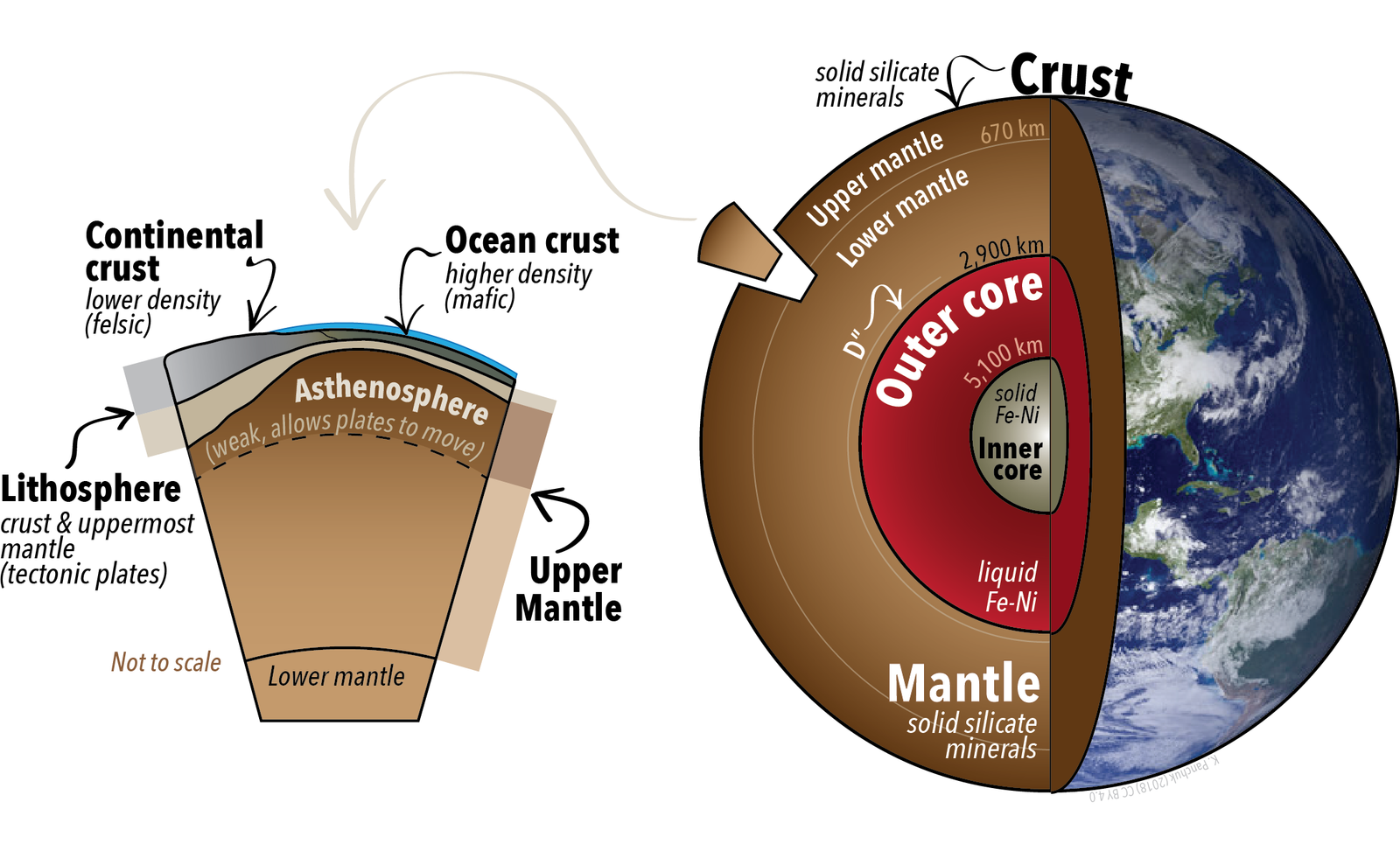
Oceanic and continental lithosphere
Oceanic and continental lithospheres differ significantly in composition, density, thickness, and formation processes.
| Feature | Oceanic lithosphere | Continental lithosphere |
|---|---|---|
| Composition and density | Primarily composed of Basaltic Rocks, which are rich in iron and magnesium (Mafic). This composition contributes to its higher density, typically ranging from 2.9 – 3.3 g/cm³ | Composed mainly of Granitic Rocks, which are richer in silica and aluminum (Felsic). This results in a lower density, generally between 2.7 – 2.9 g/cm³. |
| Thickness | Typically, 5 to 10 Km thick but can reach up to about 100 km with age as it cools and thickens over time. | Generally thicker, ranging from 30 to 60 Km, and can exceed 200 km beneath mountain ranges due to tectonic forces |
| Formation | Formed at mid-ocean ridges | Formed from sedimentation and tectonics |
Original-source note: Thickness values are reproduced exactly as stated in the original notes. Their use of crust and full-lithosphere thickness remains unresolved within the supplied source.

The cross-section shows crust plus uppermost mantle as lithosphere. It identifies the underlying asthenosphere as relatively soft and able to flow, and shows thicker lithosphere beneath continents than beneath oceans.
Questions from the chapter
Write on the following – (a) Lithosphere composition? [UPPSC ACF (Main) 2018, Environmental Science Optional | P1/1(a) | 8 M | 150 Words].
Write notes on – Lithosphere with a suitable diagram [UPPSC ACF (MAIN) 2017, Environmental Science Optional | 20 M].
Exam attributions follow the supplied chapter.
Quick revision
- The lithosphere comprises the crust and uppermost mantle.
- The chapter describes sedimentary, metamorphic and basaltic rocks and a peridotite-rich upper mantle.
- Its comparison distinguishes basaltic/mafic oceanic material from granitic/felsic continental material.
Related concepts from earlier chapters
Related topics
- Hydrosphere and Geosphere: Weathering, Groundwater and Water Quality
- Biosphere: Meaning and Abiotic, Biotic and Energy Components
Chapter 3 index
- Hydrosphere: Meaning, Hydrology and Components
- Atmosphere and Hydrosphere Interactions: Water, Heat and Feedbacks
- Hydrosphere and Geosphere: Weathering, Groundwater and Water Quality
- Lithosphere: Composition and Oceanic–Continental Comparison
- Biosphere: Meaning and Abiotic, Biotic and Energy Components