
Components of Environment: Biotic, Abiotic, Energy and Built Systems
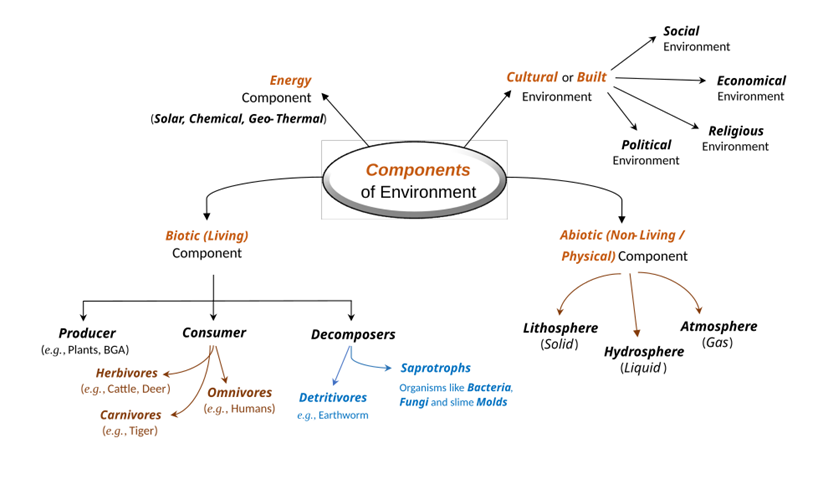
The Environment encompasses all the external conditions and factors—both living (biotic) and non-living (abiotic)—that surround and influence organisms. These components interact continuously to sustain life on Earth. Broadly, environmental components can be classified into :
In this classification, living organisms, physical factors, energy sources and human-created constructs are treated as connected parts of the environment. The chapter explains each component through definitions, examples and a compact classification diagram.
Basic Components and Biotic (Living) Components
Contents / Index
- Biotic (Living) Components
- Abiotic (Non-living/Physical) Components
- Energy Component
- Cultural or Built Environment.
| Exam Corner / Previous Year Question |
|---|
| Q. What do you mean by the term Environment? What are its Basic Components? [Arunachal PSC ACF (MAIN) 2012 | Environmental Science Optional | 4 M] Hint: Treat it as a short definition-plus-classification question. Define environment briefly, then list the four source categories: Biotic, Abiotic, Energy, and Cultural or Built Environment. A compact four-branch classification diagram can present the answer efficiently. |
BIOTIC (LIVING) COMPONENTS
Biotic components include all living organisms. They form complex, interdependent relationships within ecosystems. Based on their nutritional habits, biotic components are further categorized into –
1. Autotrophs (Producers) : Organisms that synthesize their own food from simple inorganic substances (e.g., carbon dioxide and water) using an energy source, typically sunlight (Photosynthesis).
Examples : Green plants, algae, and some bacteria (e.g., Cyanobacteria).
In regions without sunlight—such as deep-sea hydrothermal vents—certain bacteria perform Chemosynthesis by using chemical energy (often from hydrogen sulphide or methane) to produce food.
2. Heterotrophs (Consumers) : Organisms that feed on other organisms or organic matter because they cannot synthesize their own food. Heterotrophs are also called Phagotrophs because they ingest organic material.
Types
- Herbivores (Primary Consumers): Feed directly on plants (e.g., cattle, deer).
- Carnivores : Feed on other animals.
- Omnivores : Feed on both plants and animals (e.g., bears, humans).
- Secondary Consumers : Feed on herbivores (e.g., small predatory birds).
- Tertiary Consumers : Feed on secondary consumers (e.g., larger predators like tigers).
3. Saprotrophs (Decomposers or Reducers) : Organisms (often Bacteria, Fungi and slime Molds) that break down dead or decaying organic material by secreting digestive enzymes, which convert complex compounds into simpler substances.
Detritivores, a type of decomposers, are organisms that feed on detritus, which is dead and decaying plant and animal matter, e.g., Earthworms, Dung beetles, etc.
Importance
- Nutrient Cycling : They recycle essential nutrients (nitrogen, phosphorus, carbon) back into the soil or water, making these nutrients available for plants (producers).
- Ecosystem Stability : Decomposers help in waste removal and prevent the accumulation of dead matter.
| Exam Corner / Previous Year Question |
|---|
| Q. Components of ecosystem and biotic factors [UPPSC ACF (Main) 2019 | Environmental Science Optional | 8+8 M] Hint: Use a two-part structure. First classify the ecosystem/environmental components. In the biotic-factors part, explain Autotrophs (Producers), Heterotrophs (Consumers) and Saprotrophs (Decomposers or Reducers), then add the source examples of herbivores, carnivores, omnivores and detritivores. |
Abiotic, Energy and Cultural/Built Components
ABIOTIC (Non-Living / Physical) COMPONENTS
Abiotic components are the non-living physical and chemical factors that shape an ecosystem. These factors directly affect the survival, growth, and reproduction of all living organisms. Major abiotic components include Lithospheric (Solid), Hydrospheric (Liquid), and Atmospheric (Gas) elements.
| Exam Corner / Previous Year Question |
|---|
| Q. Abiotic components of an ecosystem [UPPSC ACF (Main) 2018 | Environmental Science Optional | 20 M] Hint : Begin with the source definition of abiotic components, then organize the discussion under Lithospheric (Solid), Hydrospheric (Liquid) and Atmospheric (Gas) elements. Explain that these physical and chemical factors directly affect survival, growth and reproduction. Keep the chapter’s separate Energy Component classification distinct. |
ENERGY COMPONENTS : Solar and Geothermal Energy
The Sun, as the primary source of energy, drives essential ecological processes and sustains planetary systems by powering mechanisms like photosynthesis and influencing global climate patterns. On the other hand, Geothermal Energy, derived from the Earth’s internal heat, fuels natural phenomena such as volcanic activity and hydrothermal circulation, playing a crucial role in shaping Earth’s geological and ecological systems.
CULTURAL or BUILT ENVIRONMENT
Humans have created a variety of constructs collectively known as the cultural or built environment. These include social, economic, political, and religious components.
| Exam Corner / Previous Year Question |
|---|
| Q. Explain in detail the biotic and abiotic environmental factors of an ecosystem [UK PSC RFO (Main) 2012 | Environmental Science Optional | 25 M] Hint : For the biotic side, use Producers, Consumers and Decomposers with source examples. For the abiotic side, use Lithospheric, Hydrospheric and Atmospheric elements and explain their effect on organisms. A classification tree similar to the chapter diagram can organize a long 25-mark answer. |
Quick Revision
- Environmental components include Biotic, Abiotic, Energy, and Cultural or Built Environment.
- Biotic components include Autotrophs (Producers), Heterotrophs (Consumers), and Saprotrophs (Decomposers or Reducers).
- Consumers include herbivores, carnivores and omnivores; detritivores feed on dead and decaying plant and animal matter.
- Abiotic components include Lithospheric (Solid), Hydrospheric (Liquid), and Atmospheric (Gas) elements.
- The source discusses Solar and Geothermal Energy, while the classification diagram also labels Chemical energy.
- The Cultural or Built Environment includes social, economic, political, and religious components.
Conclusion
The chapter presents the environment as a system of living, non-living, energy and human-created components. Understanding these categories, their subtypes and examples provides the basic framework required for ecosystem-related Environmental Science questions in Forest Service examinations.