
The thermosphere is a layer of Earth's atmosphere situated above the mesosphere and below the exosphere, extending approximately from 80 km to 550 km above Earth's surface.
It is characterized by increasing temperatures rapidly with height, reaching up to 2,500 °C or more due to the absorption of high-energy solar radiation, particularly X-rays and Extreme Ultra-Violet (EUV) radiation, which can intensify during periods of solar activity.
However, despite these extreme temperatures, the low density of gases in this region (nearly a vacuum) means there are very few air molecules to transfer heat. As a result, the high temperatures would not feel hot to humans.
Temperature cannot be measured using an ordinary thermometer because the gases become very light due to their extremely low density.
It contains a very low concentration of gases, primarily oxygen (O₂) and nitrogen (N₂).
Contents / Index
Ionosphere and radio communication
Ionosphere : A significant portion of the thermosphere constitutes the ionosphere, a region filled with ionized particles formed when Extreme Ultraviolet (EUV) and X-ray solar radiation ionize atmospheric atoms and molecules. It plays a crucial role in radio communication by allowing shortwave radio waves to bounce off its layers.
Its density varies with the 11-year solar cycle due to changes in EUV and X-ray photon flux.
Structure and Layers : It is divided into distinct layers — the D, E, and F-layers—which result from differences in solar radiation and atmospheric composition.
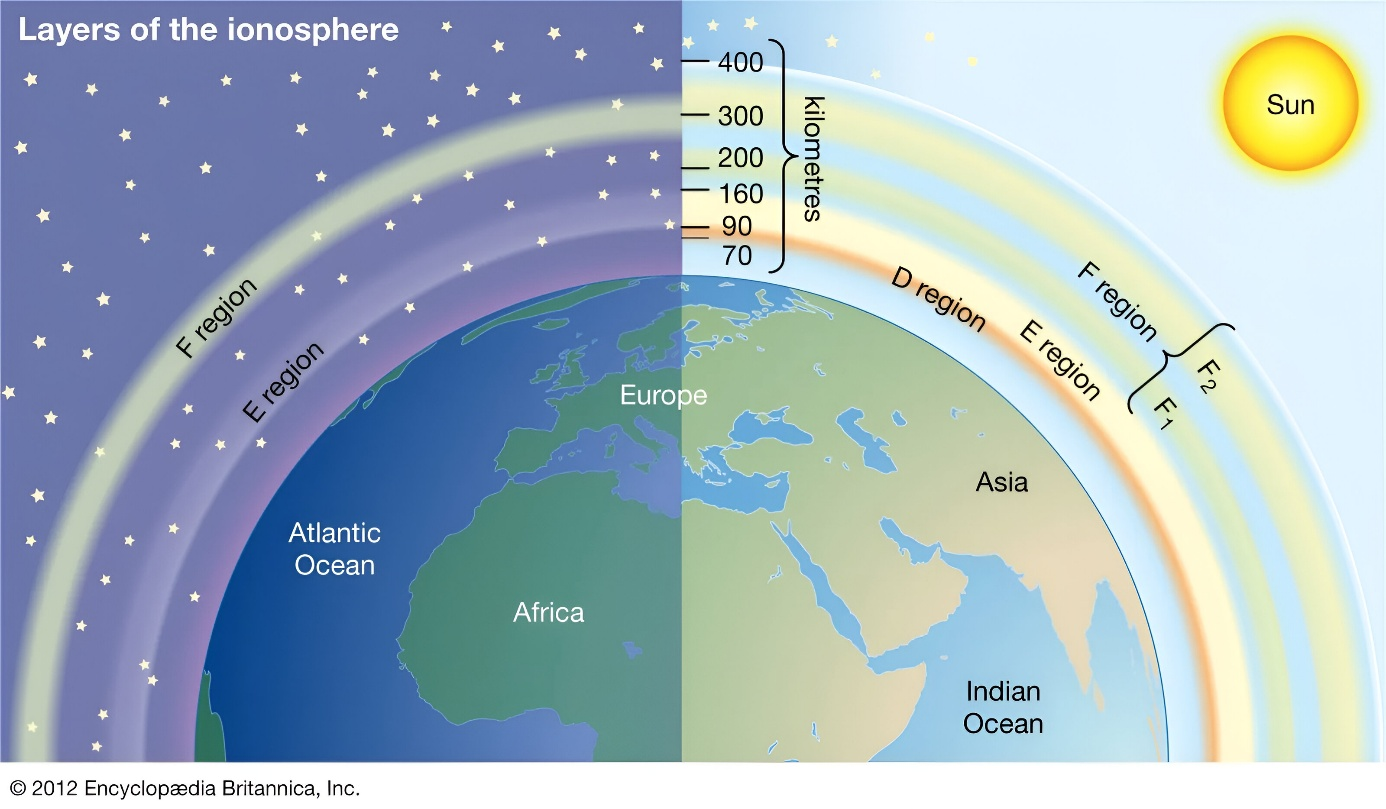
The diagram labels D, E and F regions and shows F1 and F2 within the daytime F region.
Quick revision
- Thermospheric temperature rises with height through absorption of high-energy solar radiation.
- Low gas density limits heat transfer despite high temperature.
- Solar EUV and X-ray radiation ionize atmospheric particles.
- The chapter identifies D, E and F ionospheric layers.
Related concepts from Chapter 1
- Abiotic components of environment
- Photosynthesis and biotic–abiotic interactions
- The interdisciplinary nature of environmental science
Related topics
- Mesosphere: Noctilucent Clouds, Meteors and Gravity Waves
- Aurora and Magnetosphere: Solar Wind and Earth’s Magnetic Field
- Sodium Layer: Artificial Guide Stars and Adaptive Optics
Chapter 2 index
- Composition of Atmosphere: Gases, Water Vapour and Dust
- Structure of Atmosphere: Layers, Exosphere, Homosphere and Heterosphere
- Troposphere, Stratosphere and Polar Vortex
- Ozone: Formation, Depletion and Effects on Plants
- Mesosphere: Noctilucent Clouds, Meteors and Gravity Waves
- Thermosphere and Ionosphere: Temperature and Radio Communication
- Aurora and Magnetosphere: Solar Wind and Earth’s Magnetic Field
- Sodium Layer: Artificial Guide Stars and Adaptive Optics