
Biome is a large ecosystem or a collection of smaller ecosystems, characterized by a specific climate and geography. Examples Forests biome, Tundra Biome.
Biomes are the world’s major communities, classified according to the predominant vegetation and characterized by adaptations of organism to that particular environment.
Biomes are basically a large geographical area characterized by its vegetation, soil, climate, and wildlife. Within a biome, there are many interrelated ecosystems.
Many different environmental factors play a role in determining which biomes are found where. Two key parameters are available Moisture and Temperature.
Each biome has a unique set of plants and animals that thrive in its climate.
Greek “bios” = Life.
Biome versus ecosystem
Contents / Index
A biome and an ecosystem are different concepts. An Ecosystem refers to the interaction between living and non-living things in a specific environment. A Biome, on the other hand, is a large geographic area characterized by its climate, plants, and animals. Similar biomes can occur in widely divergent places as long as the environmental conditions are appropriate for their development.
On smaller screens, scroll the table sideways to read every column.
| Characteristics | Biome | Ecosystem |
|---|---|---|
| Definition |
A large-scale geographical region defined by specific climate patterns (temperature, precipitation) and dominant vegetation types (e.g., tropical rainforest, tundra). |
A functional unit where living organisms (biotic) interact with non-living components (abiotic) (e.g., soil, water, air) in a specific area. |
| Size and hierarchy |
Spans continents or large regions (e.g., Sahara Desert biome). Comprises multiple ecosystems. Boundaries are defined largely by climate patterns such as temperature and rainfall. Similar biomes (e.g., savannas, grasslands) can appear on different continents under similar climatic conditions. Multiple biomes form the biosphere (e.g., terrestrial + aquatic biomes). |
It Can be microscopic (a drop of water containing microbes) or vast (an entire ocean), as long as there is a network of interactions between biotic and abiotic factors. Its boundaries are flexible and porous. Multiple ecosystems form a biome (e.g., Amazon rainforest biome) |
| Key determinants |
Primarily shaped by global climate (latitude, altitude, rainfall). |
Determined by local factors (soil type, sunlight, nutrient availability, species interactions). |
| Composition |
Dominant plant and animal communities adapted to the climate. Includes multiple interconnected ecosystems (e.g., forests, rivers). |
All biotic components (producers, consumers, decomposers) and abiotic components (light, pH, minerals). Specific food chains/webs. |
| Function |
Serves as a broad concept useful for global or regional comparisons (e.g., comparing biodiversity in tropical rainforests vs. temperate forests). |
Focuses on ecological interactions between organisms and their physical environment. Driven by energy flow (usually from the sun) and nutrient cycling (e.g., carbon and nitrogen cycles). |
| Stability |
Susceptible to global changes (e.g., climate change, deforestation) that alter its climate and vegetation over long periods. Recovery takes centuries due to scale. |
Affected by local disturbances (pollution, invasive species). Can recover in a decades. |
Original-source note: The centuries and decades recovery-time statements above are reproduced from the original comparison. The supplied notes do not specify conditions for these general recovery times.
A single biome (like a tropical rainforest) may encompass many distinct ecosystems, each with its own community interactions—such as riverine ecosystems, canopy ecosystems, and understory ecosystems.
The health of a biome often depends on the collective balance and functioning of its underlying ecosystems.
Classification of biomes
Biomes are large ecological areas on Earth's surface, characterized by distinct climate conditions, flora, and fauna. They are primarily classified into two broad categories:
Terrestrial Biomes: These are land-based biomes includes
Forest : Encompasses Tropical Rainforests, Temperate Forests, and Boreal forests (Taiga).
Grassland : Includes Savannas and temperate grasslands.
Desert : Characterized by low precipitation; can be Hot or Cold.
Tundra : Cold regions with grass vegetation.
Aquatic Biomes : These are water-based biomes and are divided into:
Freshwater : Lakes, rivers, streams, and wetlands.
Marine : Oceans, coral reefs, and estuaries.
It's important to note that the classification of biomes can vary among scientists. Some classifications recognize additional biomes or subcategories based on specific climatic and ecological factors. For instance, the World Wildlife Fund (WWF) identifies several major biomes, including forests, grasslands, deserts, aquatic, and tundra.
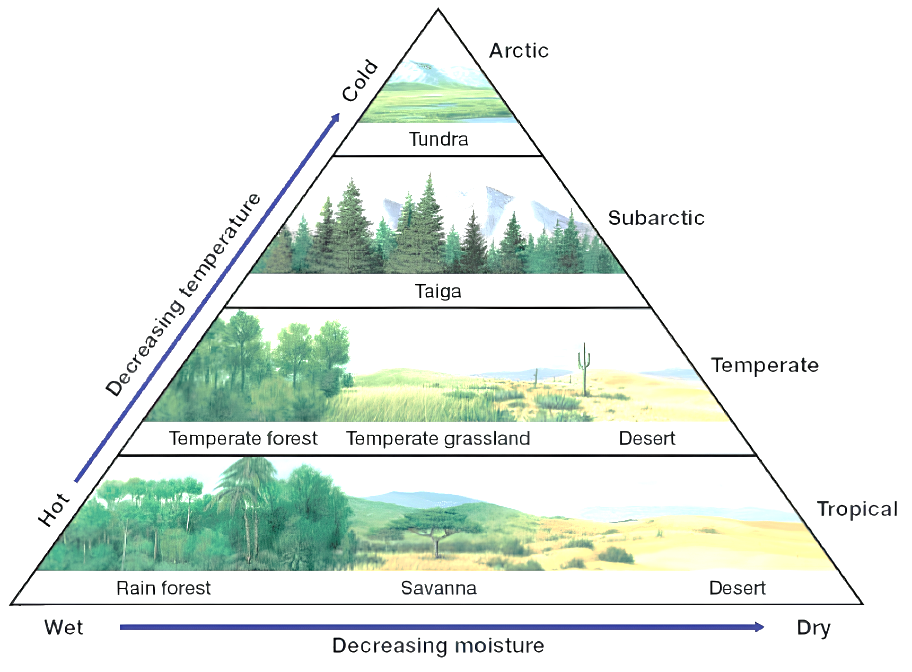
The diagram shows temperature decreasing towards the Arctic end and moisture decreasing from wet to dry. It places tundra and taiga towards the cold end, temperate forest and grassland in the temperate band, and rain forest, savanna and desert in the tropical band.
Major terrestrial biomes: regions flora and fauna
On smaller screens, scroll the table sideways to read every column.
| SN | Biome | Region | Flora | Fauna |
|---|---|---|---|---|
| 1. | Tundra | Arctic & Antarctic regions | Small shrubs, Mosses, and Lichens dominate. Growing season is short, and permafrost limits plant root growth. | Arctic foxes, polar bears, reindeer, and snow owls. |
| 2. | Taiga (boreal forest) | Northern parts of Europe, Asia, and north America | Coniferous trees like spruce, fir, and pine, which are adapted to cold and snow. Trees have needle-like leaves to reduce water loss. | Deer, bears, foxes, squirrels, birds |
| 3. | Temperate forest | Eastern North America, Central Europe, East Asia | Deciduous trees like oak, maple, and beech, as well as coniferous trees in some areas. Plants shed leaves in autumn to conserve water. | Deer, bears, foxes, squirrels, birds |
| 4. | Temperate Grassland | North American prairies, Central Asian steppes | Grasses with deep roots | Grazing animals such as bison, and rodents are common. Predators include wolves, hawks. |
| 5. | Tropical rain forest | Near the equator, such as the Amazon Basin in South America, Congo Basin in Africa, and Southeast Asia. | Diverse and dense vegetation, with large trees forming a canopy layer. Examples include mahogany, rubber trees, and a variety of ferns, vines, and epiphytes. | Jaguars, Sloths, Toucans, monkeys, and countless insects and reptiles. |
| 6. | Savannah | Found majorly in Africa (Serengeti) but also found in South America, and Northern Australia. | Dominated by grasses and scattered trees, like acacia and baobab. Fire-resistant plants and drought-tolerant species thrive here. | Large herbivores such as elephants, giraffes, zebras, and antelope. Predators like lions, cheetahs, and hyenas are also common. |
| 7. | Desert | Found in parts of Africa (Sahara), North America (Mojave), Middle East, and Australia. | Sparse vegetation, with drought-resistant plants like cacti, succulents, and small shrubs. Plants often have thick skins or spines to reduce water loss. | Animals such as camels, snakes, lizards, scorpions, and rodents, many of which are nocturnal to avoid daytime heat. |
Question from the chapter
What is biome? Differentiate between biome and ecosystem. Write a note on the major biomes on earth? [Arunachal PSC ACF (Main) 2018, Environmental Science Optional | 10 M].
Quick revision
- Biomes are large areas characterized by climate, vegetation, soil and wildlife.
- Temperature and moisture are key parameters in biome distribution.
- The chapter groups biomes as terrestrial and aquatic.
Related concepts
- Biotic and abiotic factors
- Biosphere — Chapter 3 draft
Chapter 4 reading order
- Ecology: Meaning, History and Branches
- Ecological Organization: Population and Community
- Ecosystems: Meaning, Types and Structure
- Food Chains and Food Webs: Types and Examples
- Biomes: Types and Differences from Ecosystems
- Scope of Ecology: Scales, Data and Applications