
Biological weathering is the breakdown or alteration of rocks and minerals through the activities of living organisms. Lichens, plant roots and associated microorganisms connect the biological world with the physical substrate, helping release mineral constituents and contributing to soil development.
For Environmental Science and forestry exams, this is a useful example of biotic and abiotic interactions. The organism is the biotic agent; the rock, water and mineral ions form part of its abiotic surroundings.
Contents / Index
How lichens contribute to rock weathering
A lichen is an association involving a fungus and a photosynthetic partner, usually a green alga and/or a cyanobacterium. Crustose lichens form a closely attached crust on their substrate. Some lichens colonise exposed rock surfaces and contribute to weathering by producing organic acids and interacting physically with mineral surfaces.
Weathering releases or redistributes mineral constituents. Together with accumulated organic matter and other soil-forming processes, it helps create conditions in which further organisms can establish. Lichens therefore provide a clear example of living organisms modifying their non-living environment.
Oxalic acid and calcium carbonate
The chapter uses the reaction between calcium carbonate and oxalic acid as a simplified illustration:
CaCO3 + H2C2O4 → CaC2O4 + CO2 + H2O
Here, H2C2O4 is oxalic acid and CaC2O4 is calcium oxalate. This example shows a biological product reacting with a mineral. It should not be interpreted as proof that every reaction product remains dissolved: calcium oxalate can precipitate. Actual weathering depends on the mineral, solution chemistry and local conditions.
Plant roots and biological weathering mechanisms
Roots and the organisms associated with them can modify acidity, chemical complex formation and oxidation–reduction conditions close to mineral surfaces. Growing roots can also exert mechanical stress. These mechanisms may act together, although they describe different processes.
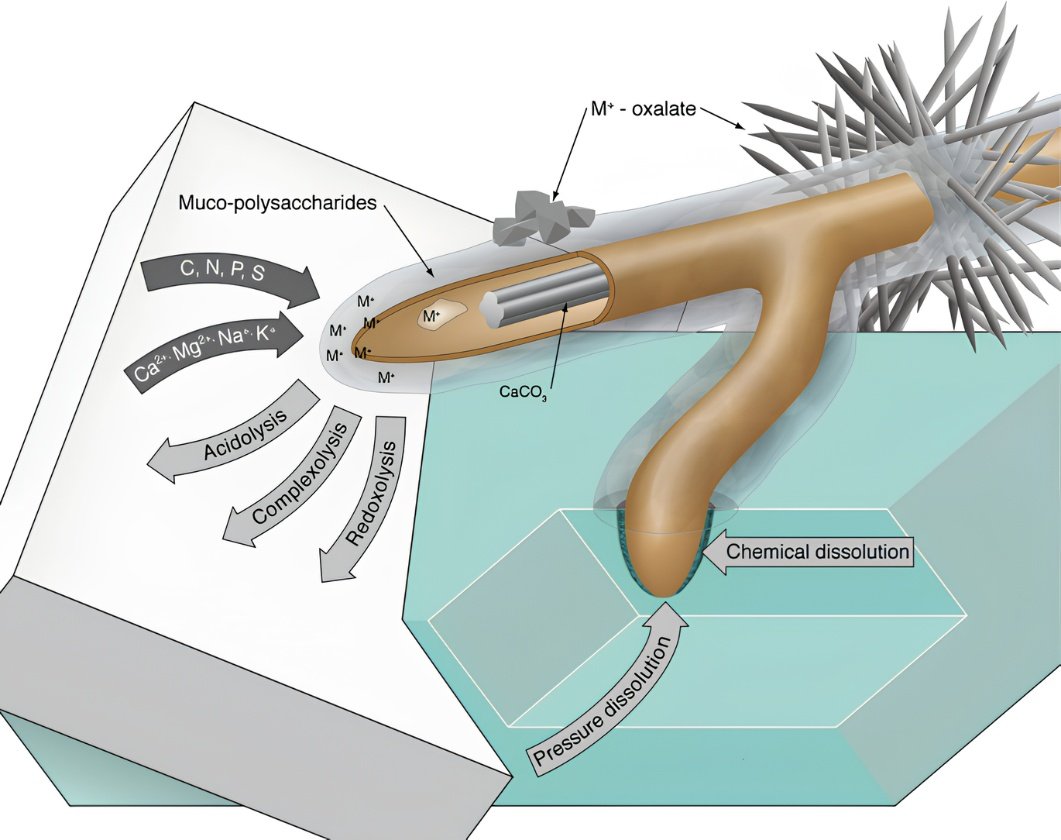
Acidolysis
Acidolysis is mineral attack promoted by acidity. Organic acids and other sources of hydrogen ions can lower pH near a mineral surface and encourage dissolution. The key idea is acid-assisted mineral alteration.
Complexolysis
Organic ligands can bind metal ions to form complexes. This binding may help remove ions from mineral surfaces and influence their transport and availability. The key idea is complex formation with metal ions; its effect depends on the ligand and mineral involved.
Redoxolysis
Changes in oxidation state can alter mineral stability and the mobility of elements such as iron and manganese. Biological activity can influence the surrounding redox conditions. Such changes may promote dissolution or precipitation, depending on the conditions; increased solubility is not a universal outcome.
Mechanical action and pressure-related dissolution
Roots growing in existing cracks can exert force and widen fractures, a process commonly described as root wedging. The source figure also labels pressure dissolution at a contact point. Distinguish these ideas: mechanical cracking breaks rock physically, while pressure dissolution refers to dissolution associated with stressed contacts.
Why biological weathering matters
- Soil development: weathering contributes mineral material that becomes part of developing soil.
- Nutrient availability: mineral alteration can release elements used by plants and microorganisms.
- Ecological succession: organisms that establish on exposed surfaces can modify conditions for later communities.
- Biotic–abiotic feedback: rock chemistry influences organisms, and organisms alter their mineral surroundings.
Soil formation also depends on climate, parent material, relief and time. Lichen or root activity is one contribution within this wider process.
Exam practice and quick revision
Practice question: Explain how lichens and plant roots contribute to biological weathering. This is a practice prompt, not an independently verified previous-year question.
Answer approach: define biological weathering, explain lichen-mediated acid action, write the carbonate–oxalic acid reaction, and distinguish acidolysis, complexolysis, redoxolysis and mechanical root action. End with their relevance to soil development and nutrient availability.
- Lichens combine fungal and photosynthetic partners.
- Acidolysis involves acidity; complexolysis involves metal-binding ligands.
- Redoxolysis involves changes in oxidation state.
- Root wedging and pressure dissolution are distinct processes.
- Biological weathering demonstrates organisms changing the abiotic environment.
Chapter index and further reading
- Environment: Meaning, Definitions, Scope and Importance
- Why Environmental Science Is Interdisciplinary
- Components of Environment
- Biotic and Abiotic Interactions: Energy Flow and Nutrient Cycling
- Biological Weathering by Lichens and Plant Roots — this post
Study source: Hornbill Institute, Chapter 1: Environment—Concept and Components, supplied study material. Further reading: National Park Service: Lichens at Devils Tower.
For the chemical mechanisms, see the research review Mineral–microbe interaction and co-evolution.