
Contents / Index
Troposphere: region of mixing
The Troposphere is the lowest layer of Earth's atmosphere, extending from the surface up to an average height of ≈ 11 kilometres.
It contains approximately 75-80% of the atmosphere's mass, with 99% of the Earth's water vapor concentrated in this layer.
All weather events, including clouds, rain, and storms, occur within the troposphere.
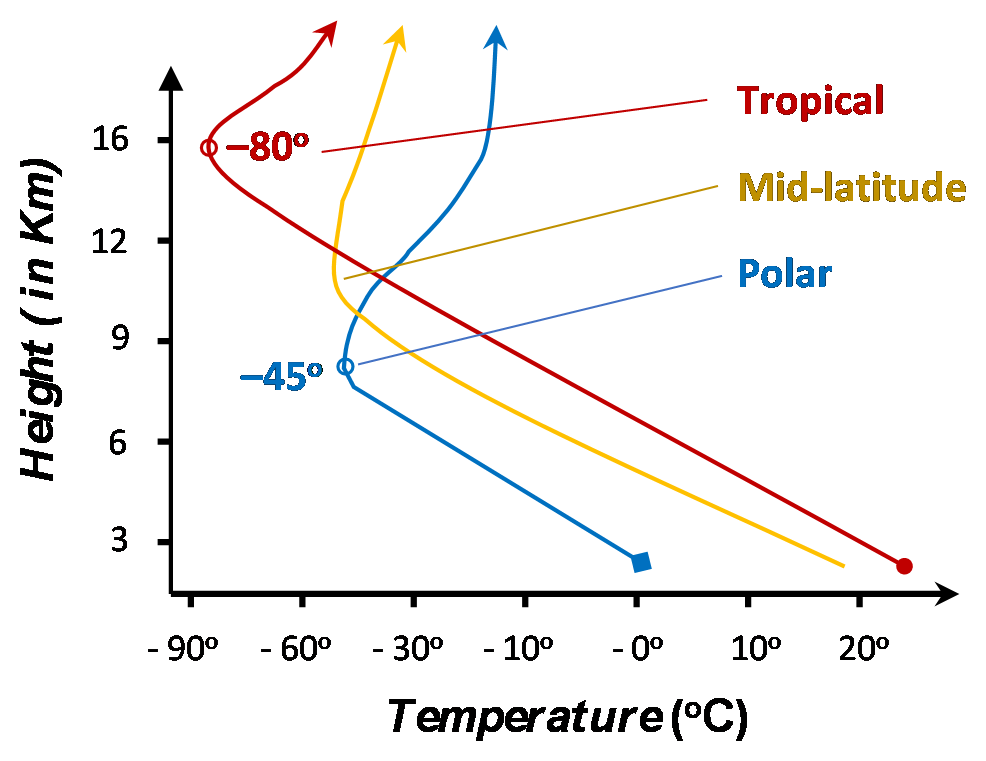
Height : Vary with ◈ Latitude – ≈ 16 km at the equator and around 6 km at the poles.
◈ Seasonal – Generally higher in summer and lower in winter.
Tropopause
Tropopause : This is the boundary layer between the troposphere and stratosphere, typically about 1.5 km thick, where mixing of air stops. The temperature at the tropopause is much lower at the equator (around – 80°C at about 17 km) compared to the poles (approximately -45°C at around 8-9 km) due to the lapse rate of about 6.5°C/km.
Its height also affected by the latitude and seasonal change.
Stratosphere: weather-free zone
The Second Layer of Earth's atmosphere, situated above the troposphere and extending up to about 50 kilometres in altitude. Unlike the troposphere where temperature decreases with altitude, the stratosphere experiences a gradual temperature increase. This phenomenon is primarily attributed to the presence of the Ozone Layer, which absorbs harmful ultraviolet radiation from the sun and converts it into heat.
Temperature gradually increases with height, reaching approximately 0°C at an altitude of 50 Km (upper boundary).
Clouds and Moisture : The lower stratosphere may occasionally host Cirrus Clouds.
Largely free from weather phenomena like storms (turbulence) and clouds, making it an ideal region for aircraft operations.
Polar vortex
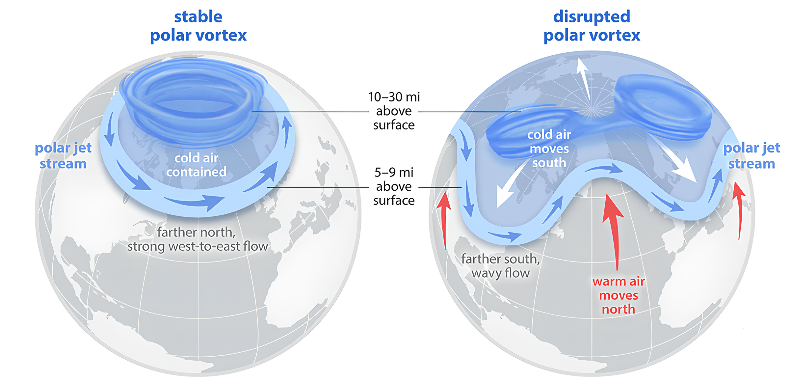
It is a large area of Low Pressure and an Intensely Rotating Cold–Air–Mass surrounding both of Earth's poles, primarily the North Pole. This rotating air generally remains stable, but during autumn, when temperatures drop sharply due to the onset of the polar night, a strong temperature contrast forms between the poles and the tropics, driving the formation of cyclonic winds.
Types of polar vortex
Tropospheric Polar Vortex : Located at lower altitudes (up to 10-15 km), this vortex is present year-round, but it is strongest during the winter.
Stratospheric Polar Vortex : Found between 15 and 50 km in altitude, this vortex is most intense during the winter, leading to a rapid drop in temperatures in both the Arctic and Antarctic regions.
Quick revision
- The troposphere contains most atmospheric mass and almost all water vapour described in the chapter.
- Tropospheric height varies with latitude and season.
- Stratospheric temperature increases with height through ozone absorption of ultraviolet radiation.
- The chapter distinguishes tropospheric and stratospheric polar vortices.
Related concepts from Chapter 1
- Abiotic components of environment
- Photosynthesis and biotic–abiotic interactions
- The interdisciplinary nature of environmental science
Related topics
- Structure of Atmosphere: Layers, Exosphere, Homosphere and Heterosphere
- Ozone: Formation, Depletion and Effects on Plants
Chapter 2 index
- Composition of Atmosphere: Gases, Water Vapour and Dust
- Structure of Atmosphere: Layers, Exosphere, Homosphere and Heterosphere
- Troposphere, Stratosphere and Polar Vortex
- Ozone: Formation, Depletion and Effects on Plants
- Mesosphere: Noctilucent Clouds, Meteors and Gravity Waves
- Thermosphere and Ionosphere: Temperature and Radio Communication
- Aurora and Magnetosphere: Solar Wind and Earth’s Magnetic Field
- Sodium Layer: Artificial Guide Stars and Adaptive Optics