
Population ecology, a vital subfield of ecology, examines how populations of organisms interact with their environment and evolve over time. It primarily focuses on various factors that influence population size, density, distribution, and age structure, as well as the processes that drive changes in these parameters over time.
A population is defined as a group of individuals of the same species inhabiting a shared space.
Populations are Dynamic entities that vary in type, form, size, density, distribution, age structure, and sex ratio. These characteristics fluctuate over time due to factors such as birth rates, death rates, immigration, and emigration. Additionally, external influences, including seasonal and annual environmental changes, natural disasters like forest fires and volcanic eruptions, and competition for resources within and between species, play a crucial role in shaping population dynamics.
Understanding these dynamics is crucial for conservation efforts, resource management, and predicting how populations respond to environmental changes.
The statistical study of populations, known as Demography, involves a set of mathematical tools used to describe population characteristics and analyse changes over time. It examines factors such as birth rates, death rates, migration patterns, and population growth to understand trends and predict future dynamics.
Population characteristics
Contents / Index
Certain characteristics are unique to populations as a whole and not applicable to individual organisms. These include attributes such as population size, density, distribution patterns, age structure, and sex ratio. These characteristics are described using numerical patterns and statistical measures, providing insights into the dynamics and health of populations. For instance, understanding the age structure of a population can help predict its growth trends, while analysing distribution patterns can reveal how individuals are spaced within a habitat. These collective properties are essential for studying how populations interact with their environment and respond to various ecological factors.
Size and density
Population Size & Density : The total size of a population is typically expressed as the number of individuals per unit of habitat space (or area) at a given time. For larger organisms, such as trees, density might be represented as 500 trees per hectare, whereas for smaller organisms like Bacteria, it could be described as 2 million bacteria per cubic meter of area. Density can also be expressed in terms of weight, such as 100 pounds of fish per hectare of water surface.
Original-source note: The original wording describes total population size in per-unit terms and uses “cubic meter of area”. This size/density wording and its units are retained for source review.

Types of density
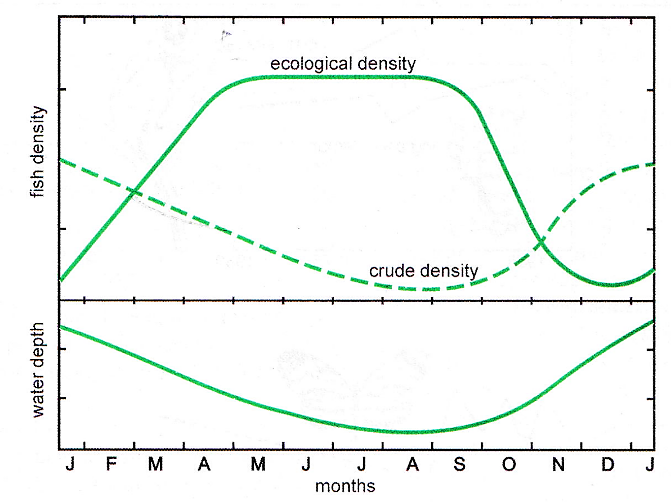
Crude density : the density (number or biomass) per unit total space.
Specific or Ecological or Economic density : density (number or biomass) per unit of habitat space, i.e., available area or volume that can actually be colonised by the population.
Figure : The crude density of small fish in the area decreases as the water level drops during the winter dry season. However, the ecological density increases in the contracting pools of water, as fish are concentrated into progressively smaller areas.
Methods of determination
Vary based on the mobility of the organisms under study. For Sessile or slow-moving species, researchers often use Quadrat Sampling, which involves analysing randomly selected plots of a specific size within the study area. In contrast, for large, mobile animals such as tigers, leopards, lions, and deer, density estimates are typically obtained through Direct Counts or by analysing Indirect Signs like pugmarks (footprints).
Dispersion patterns
Dispersion : Dispersion refers to the spatial distribution of individuals within a population relative to one another. It can be categorized into three main patterns
Uniform (Regular) Dispersion : In this pattern, individuals are evenly spaced throughout the habitat. While rare in natural settings, uniform dispersion is often observed in managed systems like croplands.
Random Dispersion : Here, the position of each individual is independent of others, resulting in an unpredictable distribution. This pattern typically occurs in habitats where environmental conditions are uniform, and interactions among individuals are minimal. An example is the dispersal of Shorea robusta seeds by wind, leading to a random settlement pattern.
Clumped Dispersion : The most common pattern in nature, clumped dispersion occurs when individuals aggregate in specific areas. This clustering can be influenced by factors such as resource availability, social behaviours, or environmental conditions. For instance, animals may form groups for mating, protection, or cooperative hunting, while plants might grow in patches where soil conditions are favourable (e.g., wet bamboo brakes in Assam region)

Factors affecting dispersion
Population dispersion—the spatial arrangement of individuals within a habitat—is influenced by several key factors.
Dispersal and dispersion
Dispersal : This refers to the movement of individuals away from their place of origin or from areas of high population density to new locations. Dispersal mechanisms can include active movement, such as animals migrating to new territories, or passive means, like plant seeds being carried by wind or water.
Dispersion : This term describes the spatial arrangement of individuals within a population in a specific area at a given time. Common dispersion patterns include : Clumped, Uniform, Random.
Resource Availability : Individuals often cluster in areas where essential resources like food and water are abundant, leading to clumped dispersion patterns.
Social Interactions : Behaviours such as territoriality can result in uniform dispersion, while social grouping behaviours may cause clumped dispersion.
Environmental Factors : Climate, topography, and soil conditions can affect where populations establish, influencing their dispersion.
Competition : Intense competition for resources can lead to uniform dispersion as individuals space themselves to minimize conflicts.
Predation Pressure : High predation pressure in a particular area may make an individual to disperse to safer locations where they face lower risks of predation.
Dispersal Mechanisms : The methods by which organisms move, such as seed dispersal by wind or animal movement patterns, can result in random dispersion if movement is unpredictable.
Presence of physical barriers like rivers or mountains
Mating Opportunities : Dispersal may occur in search of potential mates or to avoid inbreeding within populations, promoting gene flow and genetic diversity.
Age structure
Age Structure : In most populations, individuals exist in different age groups, and the distribution of individuals across these age groups is referred to as the Age Structure of the population. The age structure plays a crucial role in determining the population's current reproductive status and helps predict its future growth trends.
From an ecological perspective, populations are typically divided into three major ecological age groups:
Pre-reproductive : Individuals that have not yet reached reproductive maturity.
Reproductive : Individuals that are capable of reproduction.
Post-reproductive : Individuals that are beyond their reproductive phase.
The relative duration of these age groups, as a proportion of an organism's lifespan, varies significantly across species
In humans, the three age groups are relatively equal, with approximately one-third of the lifespan falling into each category.
Original-source note: The approximate one-third division of human lifespan is retained as stated. The supplied notes do not specify conditions or population data for this generalization.
Many plants and animals have a disproportionately long pre-reproductive phase.
Some organisms, particularly insects, exhibit extremely long pre-reproductive periods, a very short reproductive phase, and no post-reproductive phase at all.
Types of age pyramids
These graphical representations are essential for understanding population dynamics and predicting future growth trends.
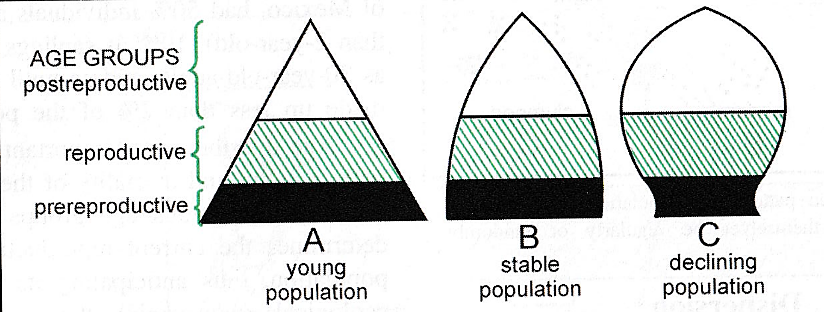
A pyramid with a broad base indicates a high percentage of young individuals, characteristic of rapidly growing populations with a high birth rate. In such populations, each successive generation outnumbers the previous one, leading to exponential growth, as seen in organisms like yeast, houseflies, and paramecia.
A bell-shaped polygon represents a more balanced age structure, where the pre-reproductive and reproductive groups are nearly equal in size, and the post-reproductive group is the smallest. This pattern is typical of populations with stable and slow growth.
In contrast, an urn-shaped figure signifies a declining population with a low percentage of young individuals. Here, the pre-reproductive group is significantly smaller than the reproductive and post-reproductive groups, often due to a drastically reduced birth rate. This structure suggests that the population is aging (dying off).
Questions from the chapter
Define ecological density? [IGNFA, Environmental Science, 2013-15 | 2 Marks]
Give an outline of the characteristics of population and its effects on environment? [UPPSC Forest (Main) 2019, 20 M].
Differentiate between Community and Population [UPPSC Forest (Main) 2021, 8 M].
Elaborate Biological attributes of population? [IGNFA (Probation) 2014-16, 5 M].
Explain Biological attributes of population and its implication in wildlife management? [IGNFA (Probation) 2016-18, 2018-20, 10 M].
Exam attributions follow the supplied notes.
Related background
Components of Environment: Biotic & Abiotic
Chapter 5 reading order
- Population Ecology: Density, Dispersion and Age Structure
- Natality, Mortality, Life Tables and Survivorship Curves
- Population Growth: Biotic Potential and Environmental Resistance
- Population Regulation: Density Dependent and Independent Factors
- r and K Selected Species: Traits and Human Impacts
- Carrying Capacity: Types and Forest Management Applications
- Population Dispersal and Fluctuation: Causes and Consequences
- Habitat: Components, Types, Fragmentation and Conservation
- Ecological Niche: Types, Roles and Habitat Forming Species
- Ecophene, Ecotype and Ecospecies: Adaptive Responses