
The hydrosphere encompasses all the waters on, under, and over the surface of Earth. It is a discontinuous layer of water in all its forms: liquid, solid (ice and snow), and gas (water vapor). Essentially, it's the combined mass of water found on the planet, regardless of its state or location.
Hydrology is the scientific study of the movement, distribution, and management of water on the Earth's surface and beneath the surface, including the study of its physical & chemical properties, and its relationship with the living and material components of the forest ecosystem.
Contents / Index
Components of the hydrosphere
Oceans
Ocean : Out of the total water on Earth, 96.5% is oceanic (saline) water, making it the largest component of the hydrosphere. It is saline primarily because of sodium chloride, with about 35 grams of dissolved salts per liter. These vast water bodies act as heat reservoirs, influencing global weather patterns and supporting a wide array of marine ecosystems.
Freshwater
Freshwater : The remaining 2.5% of Earth's water is Freshwater, of which approximately 68.5% is locked in Ice Sheets and Glaciers (e.g., Antarctica, Greenland, the Himalayas). This water remains largely inaccessible due to its remote location. Approximately 22.5% of the freshwater is groundwater, while about 2.5% is Surface and Atmospheric Water.
Saline water outside oceans
Saline Water (Excluding Oceans) : About 0.9% of Earth's water is saline and found in lakes and underground aquifers. Notable examples include the Dead Sea and the Great Salt Lake.
Water in living organisms
Water in Living Organisms : Water within living organisms forms a negligible portion of the hydrosphere.
Water distribution in the original notes
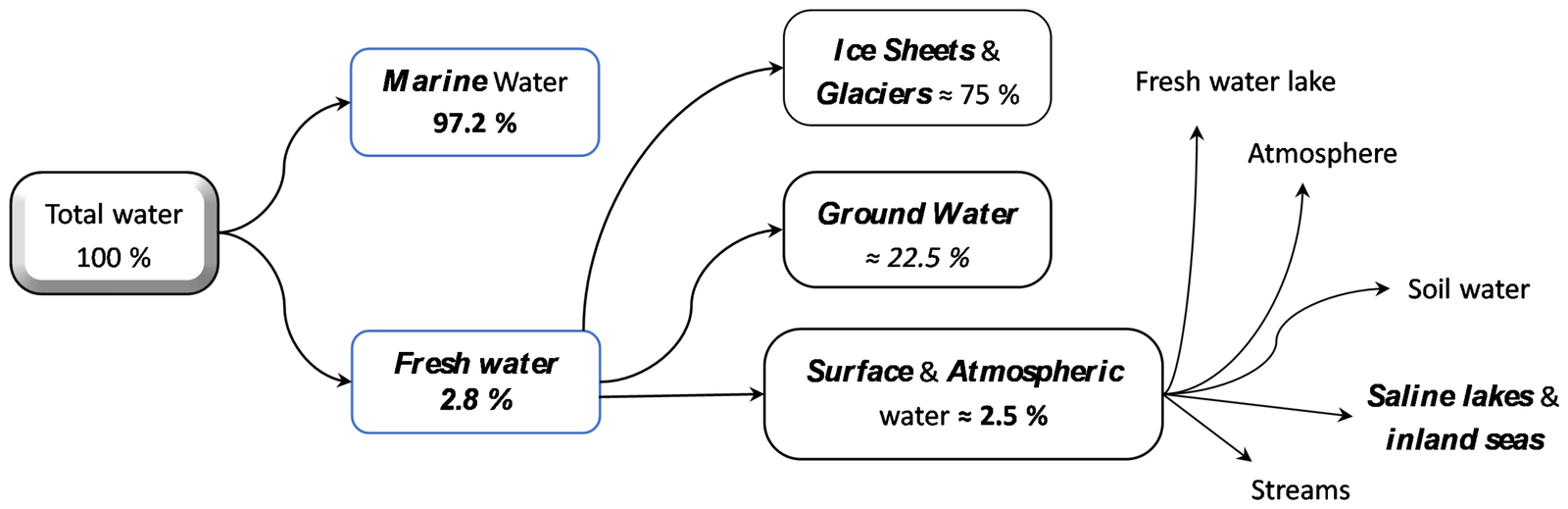
Original-source note: The original text gives ocean water as 96.5%, freshwater as 2.5% and glacier storage as 68.5%; its diagram gives 97.2%, 2.8% and approximately 75%, respectively. Both are preserved as supplied. The freshwater subshares in the text do not total 100%; no figures have been reconciled.
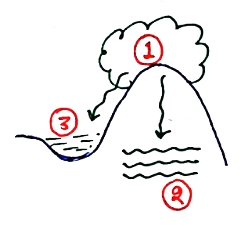
Original-source note: The original sketch does not explain labels 1–3.
Water in different parts of the Earth system

The diagram connects ocean water, atmospheric water and collection over land through evaporation, condensation and precipitation. It also labels transpiration.
Questions from the chapter
Write on the following – Composition of hydrosphere [UPPSC ACF (Main) 2019, Environmental Science Optional | P1/1(e) | 8 M | 150 Words]
Exam attributions follow the supplied chapter.
Quick revision
- The hydrosphere includes water on, under and over Earth’s surface in liquid, solid and gaseous forms.
- Hydrology studies water movement, distribution, management, properties and relationships with ecosystem components.
- The chapter identifies oceans, freshwater, non-oceanic saline water and water in organisms.
Related concepts from earlier chapters
Related topics
- Atmosphere and Hydrosphere Interactions: Water, Heat and Feedbacks
- Hydrosphere and Geosphere: Weathering, Groundwater and Water Quality
- Biosphere: Meaning and Abiotic, Biotic and Energy Components
Chapter 3 index
- Hydrosphere: Meaning, Hydrology and Components
- Atmosphere and Hydrosphere Interactions: Water, Heat and Feedbacks
- Hydrosphere and Geosphere: Weathering, Groundwater and Water Quality
- Lithosphere: Composition and Oceanic–Continental Comparison
- Biosphere: Meaning and Abiotic, Biotic and Energy Components