
Ecosystem productivity refers to the rate of dry matter production (biomass) generated per unit area over a specific period. It is crucial for understanding the health and functionality of ecosystems, as it indicates their capacity to support various life forms.
Productivity is measured as the amount of mass accumulated per square meter per year (g/m²/yr) or energy in kilocalories per square meter per year (kcal/m²/yr).
There are two main types of productivity — Primary Productivity and Secondary Productivity.
Primary productivity
Contents / Index
Primary productivity is the rate at which primary producers, such as plants and certain bacteria, convert energy from sunlight through photosynthesis or from chemical processes through chemosynthesis into organic substances. Primary productivity forms the foundation of energy flow within ecosystems.
Primary productivity is categorized into two types :-
Gross Primary Productivity (GPP) : This is the total amount of energy assimilated by primary producers during a given period. It includes all energy captured through photosynthesis or chemosynthesis, including the portion used by producers for respiration.
Net Primary Productivity (NPP) : This is the energy remaining after accounting for the respiration of primary producers. NPP represents the biomass available for consumption by herbivores and decomposers.
The relationship between GPP and NPP is expressed by the following equation:
NPP = GPP – Cellular Respiration
Secondary productivity
Secondary productivity is defined as the accumulation of biomass by heterotrophic organisms over a specific period. It depends on the efficiency of energy transfer between trophic levels and the quality of biomass consumed; thus, it is not considered true productivity.
Source-review note: The original conclusion “not considered true productivity” is retained; the intended distinction is not explained further in the source.

Factors affecting productivity
Solar Radiation : Plants perform photosynthesis utilizing specific wavelengths of radiation known as Photosynthetically Active Radiation (PAR). Variations in PAR can significantly influence productivity.
Temperature : Extremely high or low temperatures affect the physiological activities of producers, including the production and accumulation of dry biomass.
Moisture : Fluctuations in precipitation, soil moisture, and transpiration rates directly impact productivity.
Availability of Mineral Nutrients : The presence and interaction of various essential minerals greatly influence productivity levels.
Biotic Activity : Interactions among organisms, including human interference, also significantly affect ecosystem productivity.
Dust, cloudiness, leaf arrangement & Concentration of CO2, etc.
Productivity of Indian forests
Indian forests have historically shown lower productivity levels compared to the global average. For instance, the average productivity of Indian forests is approximately 1.0 cubic meter per hectare per year, whereas the global average stands at 3.0 cubic meters per hectare per year. This disparity is attributed to factors such as deforestation, land degradation, and suboptimal forest management practices.
Indian Forest = 0.77 cum per ha per year
TOFs = 3.06 cum per ha per year
Source-review note: The original gives Indian forest productivity as both approximately 1.0 and 0.77 cum per ha per year, and TOFs as 3.06. Dates, comparable measurement basis and a full form for TOFs are not supplied.
Increasing primary productivity
Primary productivity can be increased or manipulated to some extent, with the goal of benefiting ecosystems and human society.
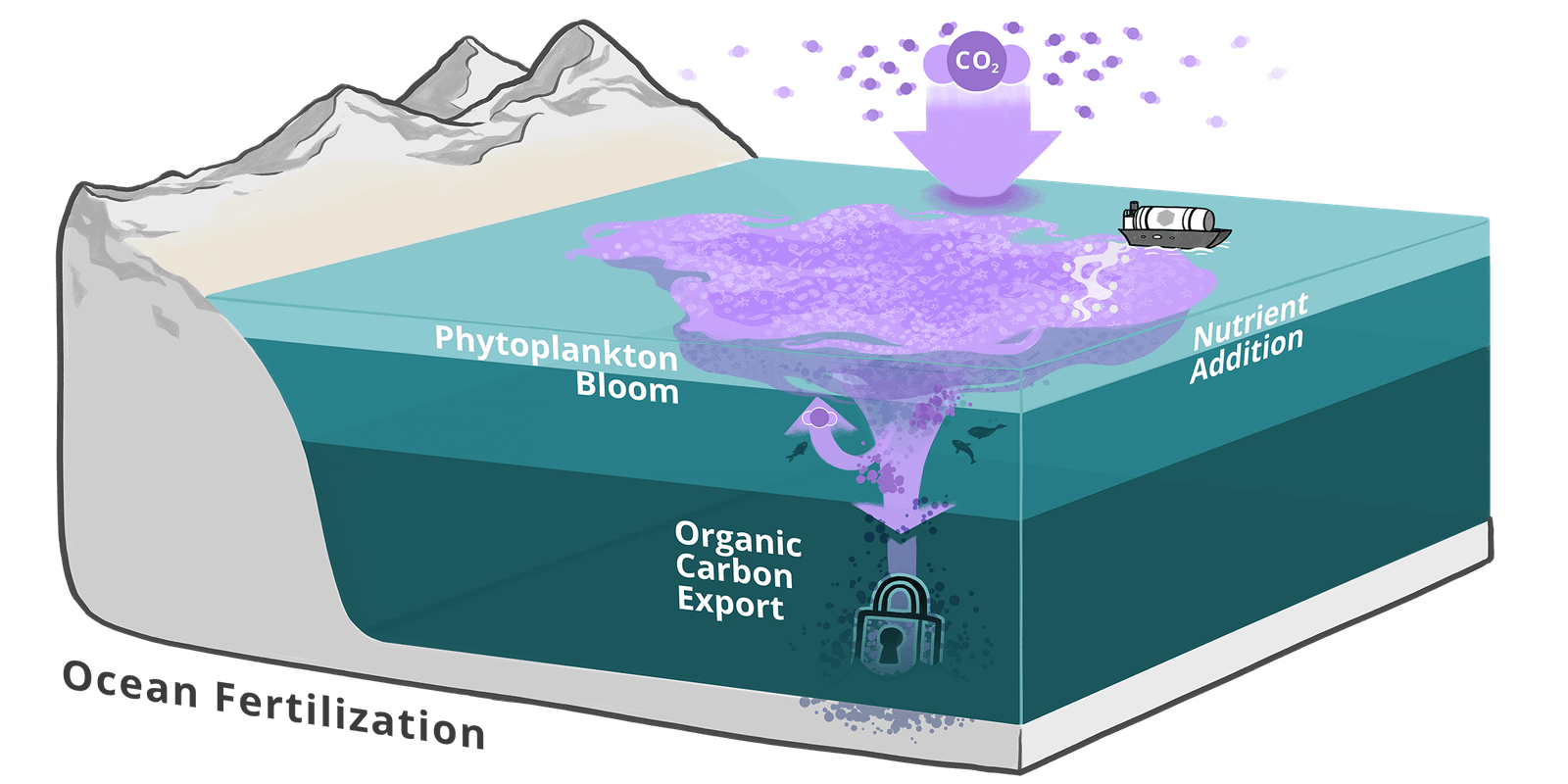
Fertilization : The application of nutrients, such as nitrogen and phosphorus, can increase primary productivity in both terrestrial and aquatic ecosystems.
Irrigation : The availability of water is a critical factor for primary productivity
Restoration of degraded ecosystems
Management of fishing and harvesting : In aquatic ecosystems
Source-review note: Restoration and management of fishing/harvesting are brief original prompts, not fully explained procedures. The accompanying ocean-fertilization image is retained as a source illustration, not an independently assessed recommendation.
Questions from the chapter
What is primary productivity and how is it defined?
What are the two main types of primary productivity and how do they differ?
What are the main factors that affect primary productivity in an ecosystem?
What is the significance of primary productivity in the functioning of ecosystems?
How does primary productivity influence the amount of atmospheric carbon dioxide?
Can primary productivity be increased or manipulated to benefit ecosystems and human society? If so, how?
Exam attributions are reproduced from the supplied notes; unattributed questions remain unattributed.
Chapter 6 reading order
- Energy Flow in Ecosystems: Processes and Thermodynamic Laws
- Energy Flow Models: Single Channel, Y Shaped and Universal
- Biomass: Types, Accumulation and Energy Uses in India
- Ecosystem Productivity: Primary, Secondary and Influencing Factors
- Methods of Measuring Primary Productivity
- Primary Productivity Patterns in Terrestrial and Aquatic Ecosystems