
The biosphere is a complex and interconnected global sum of all ecosystems on Earth, where living things interact with each other and their physical surroundings. It is characterized by a constant exchange of energy and materials that are vital for life.
Contents / Index
Biosphere as a global ecological system
The Biosphere is the global ecological system that integrates all living beings and their interactions with the physical elements of the Earth, namely the Lithosphere (Land), Hydrosphere (Water), and Atmosphere (Air). It encompasses all ecosystems on Earth, where life exists, from the deepest oceanic trenches to the upper reaches of the atmosphere.
Biosphere = Greek words Bíos (Life) + Sphaîra (Sphere) = Spherical zone of life on Earth
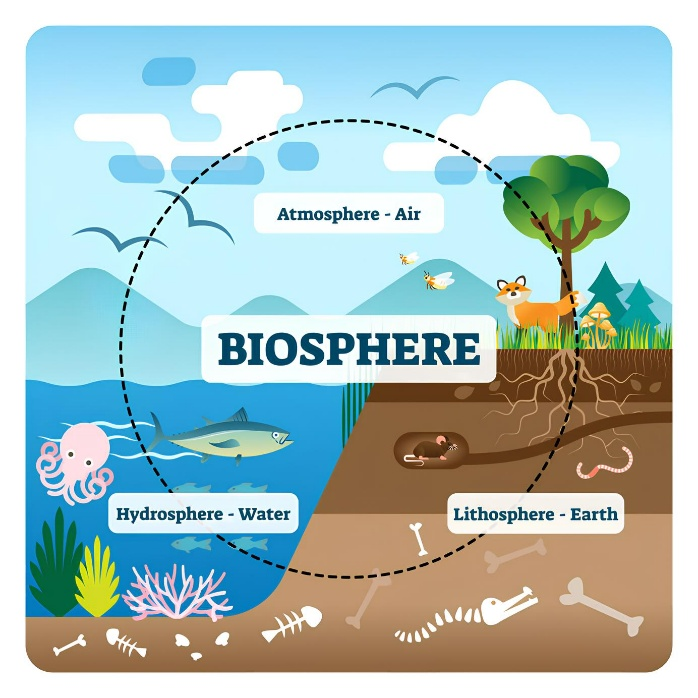
Components of the biosphere
Biosphere has three basic components. These are (A) abiotic (physical and inorganic) components; (B) biotic (organic) components and (C) energy components
Abiotic components
Abiotic Components : These components broadly consist of all non-living elements which are essential for the survival of all living organisms. These are (i) Lithosphere (solid part of the earth crust), (ii) Atmosphere and (iii) Hydrosphere. Mineral nutrients, certain gases and water are the three basic requirements of organic life. Soils and sediments constitute the chief reservoir of mineral nutrients. Atmosphere constitutes the chief reservoir of gases essential for organic life. Ocean constitutes the chief reservoir of liquid water. where all these three reservoirs intermingle and that area becomes the most fertile area for organic life.
Original-source note: This paragraph preserves the original abbreviated lithosphere description and “most fertile” wording. The chapter elsewhere defines the lithosphere as crust plus uppermost mantle.
Biotic components
Biotic Components : These include all living organisms categorized into –
Plants : Autotrophic organisms that produce food through photosynthesis.
Animals : Heterotrophic organisms that rely on plants or other animals for food.
Microorganisms : Decomposers such as fungi and bacteria that break down organic matter.
Energy components
Energy Components : All organisms in the biosphere are like machines which use energy to work and also to convert one form of energy into another.
Questions from the chapter
Describe the following – (a) Biosphere
निम्नलिखित का वर्णन कीजिये – (a) जैव मण्डल [UPPSC ACF (Main) 2019, Environmental Science Optional | P1/4(a) | 20 M]
Exam attributions follow the supplied chapter.
Quick revision
- The biosphere is the global sum of ecosystems and their interactions.
- It connects organisms with lithosphere, hydrosphere and atmosphere.
- Its components are abiotic, biotic and energy components.
- The source groups living organisms as plants, animals and microorganisms.
Related concepts from earlier chapters
Related topics
- Hydrosphere: Meaning, Hydrology and Components
- Atmosphere and Hydrosphere Interactions: Water, Heat and Feedbacks
- Lithosphere: Composition and Oceanic–Continental Comparison
Chapter 3 index
- Hydrosphere: Meaning, Hydrology and Components
- Atmosphere and Hydrosphere Interactions: Water, Heat and Feedbacks
- Hydrosphere and Geosphere: Weathering, Groundwater and Water Quality
- Lithosphere: Composition and Oceanic–Continental Comparison
- Biosphere: Meaning and Abiotic, Biotic and Energy Components