Environment : Meaning, Scope, Components & Interdisciplinary Nature | UPSC / IFoS & State Forest Sevice Forestry Optional Notes
Look around you right now. The chair you are sitting on, the air you are breathing, the invisible sunlight filtering through the window, the person next to you, the phone in your hand — all of this is your environment. And that is exactly where UPSC & UPPSC Environmental Science begins: with a deceptively simple question — what surrounds us, and how does it shape us?
1.1 INTRODUCTION
Contents / Index
The environment refers to everything that surrounds a living organism — people, places, objects, and phenomena — whether natural or man-made.
In the early stages of human history, the environment was perceived only in terms of physical elements such as land, air, water, and living organisms. Over time, as society evolved, the concept of environment expanded to include social, economic, and political dimensions as well.
Definition — Environment The environment is the sum of all external conditions surrounding an organism, including complex physical, chemical, and biological factors, as well as social and cultural conditions, that influence its growth, development, and survival.
Did You Know? – Etymology
The word “environment” is derived from the French term Environ or Environer, meaning ‘to surround’.
1.2 SCOPE / IMPORTANCE OF ENVIRONMENTAL SCIENCE
If Section 1.1 answered ‘what is the environment’, this section answers two follow-up questions that examiners love – the ‘why’ and the ‘what’.
Importance highlights the “why” — why environmental science is crucial for our well-being and the planet’s health. Scope emphasizes the “what” — what are the different areas and issues environmental science deals with.
Scope
• Understanding Natural Processes : This involves studying how natural systems function, including ecosystems, climate patterns, and geological processes.
• Human–Environment Interaction : Environmental science examines how human activities affect the environment, including land use changes, pollution, and resource consumption.
• Impact Assessment : It assesses the consequences of human actions on natural systems and seeks to measure and predict these impacts.
Importance
• Ecosystem Dynamics : This area focuses on understanding the mechanisms of ecosystems, including organism interactions, energy flow, and nutrient cycling. It aims to elucidate how these systems maintain balance and respond to changes.
• Natural Resources Management : This involves the study of how resources such as water, soil, forests, and minerals are distributed, managed, and conserved to ensure their sustainability for future use.
• Pollution Control : Here, the focus is on identifying pollution sources, understanding its environmental and health impacts, and developing strategies for prevention, treatment, and remediation of pollution in air, water, and soil.
• Climate Change Science : This encompasses research into the drivers of climate change, its global effects, and the development of strategies for mitigation (reducing greenhouse gas emissions) and adaptation (adjusting to climate impacts).
• Biodiversity Conservation : This discipline is dedicated to the protection of species diversity, habitats, and ecosystems, emphasizing the importance of biodiversity for ecological stability and human well-being.
• Environmental Policy and Legislation : It involves the creation, analysis, and enforcement of laws and policies aimed at protecting the environment. This includes international agreements, national laws, and local regulations.
• Human–Environment Interaction : This aspect examines how human activities influence the environment, assessing impacts like urbanization, industrialization, and agriculture, and devising methods to reduce negative environmental footprints.
• Sustainability Practices : This field explores sustainable development principles, aiming to harmonize economic growth, social development, and environmental protection to ensure that current human needs are met without compromising future generations’ resources.
Why Environmental Science is Interdisciplinary
Environmental science is inherently Interdisciplinary Science because it necessitates the integration of knowledge from various disciplines like biology, chemistry, and physics, social sciences (such as economics and sociology), and engineering, to comprehensively understand the environmental issues, and then effectively address it.
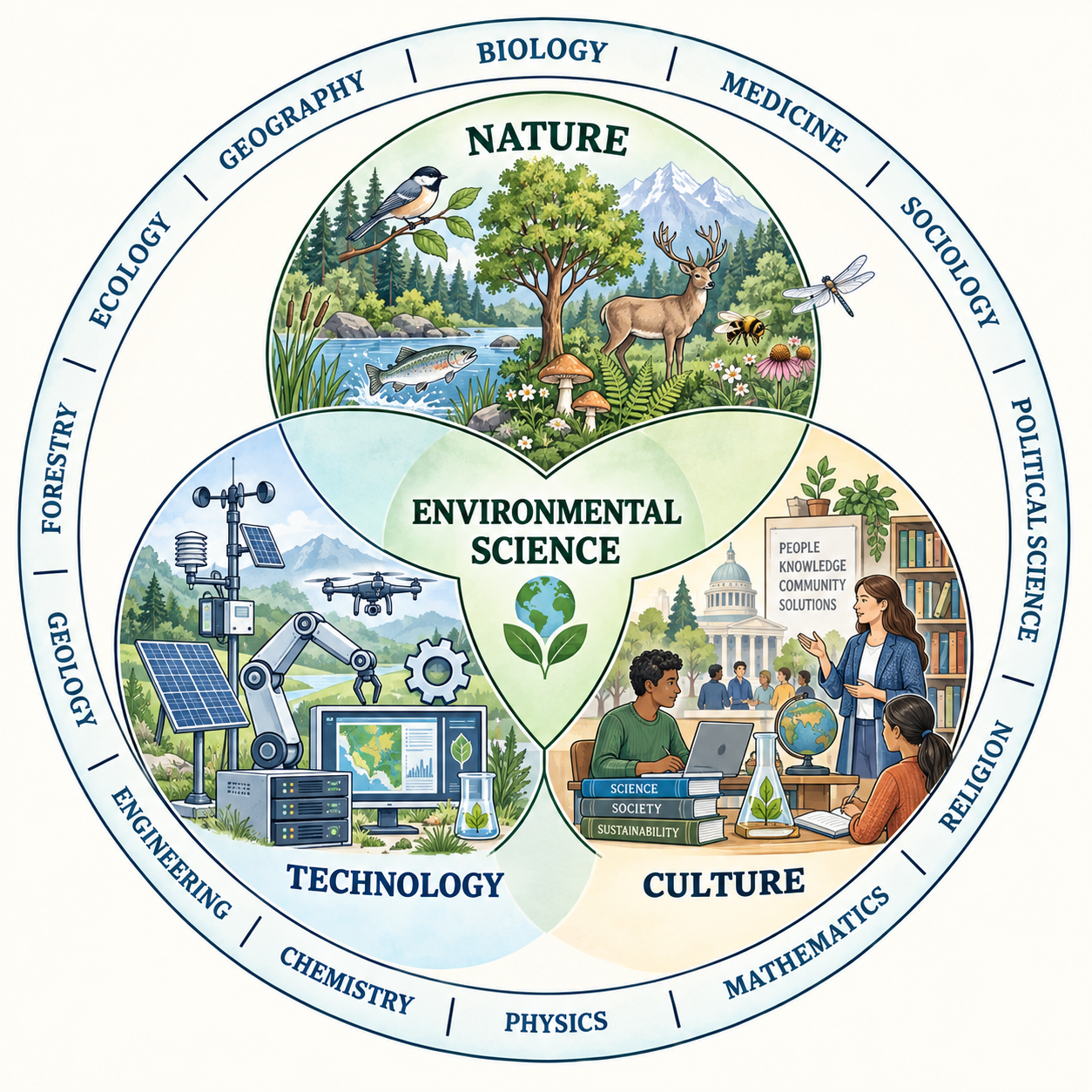
For example, to understand the causes and consequences of climate change, we need to consider:
• The physics of the atmosphere and oceans.
• The chemistry of greenhouse gases, their sources, and their impacts on the environment.
• The biology of ecosystems and their responses to climate change.
• The social and economic factors that drive greenhouse gas emissions, and the public’s perception of climate change.
Effective environmental management often requires collaboration among experts from different fields.
Exam Corner – Previous Year Question
Q. Why is environmental science considered as an Interdisciplinary Science? What is the Scope of environmental science?
Arunachal PSC ACF (Main) 2018 | Environmental Science Optional | 4 Marks
💡 Hint :
Split the answer in two halves. Part 1 – argue interdisciplinarity by mapping any ONE issue (e.g., climate change) to physics, chemistry, biology, sociology and engineering simultaneously. Part 2 — list the SCOPE dimensions crisply: understanding natural processes, human–environment interaction, and impact assessment. Add one line linking the two: an issue this broad NEEDS an interdisciplinary lens.
Innovative Solutions Developed Through Interdisciplinary Environmental Research
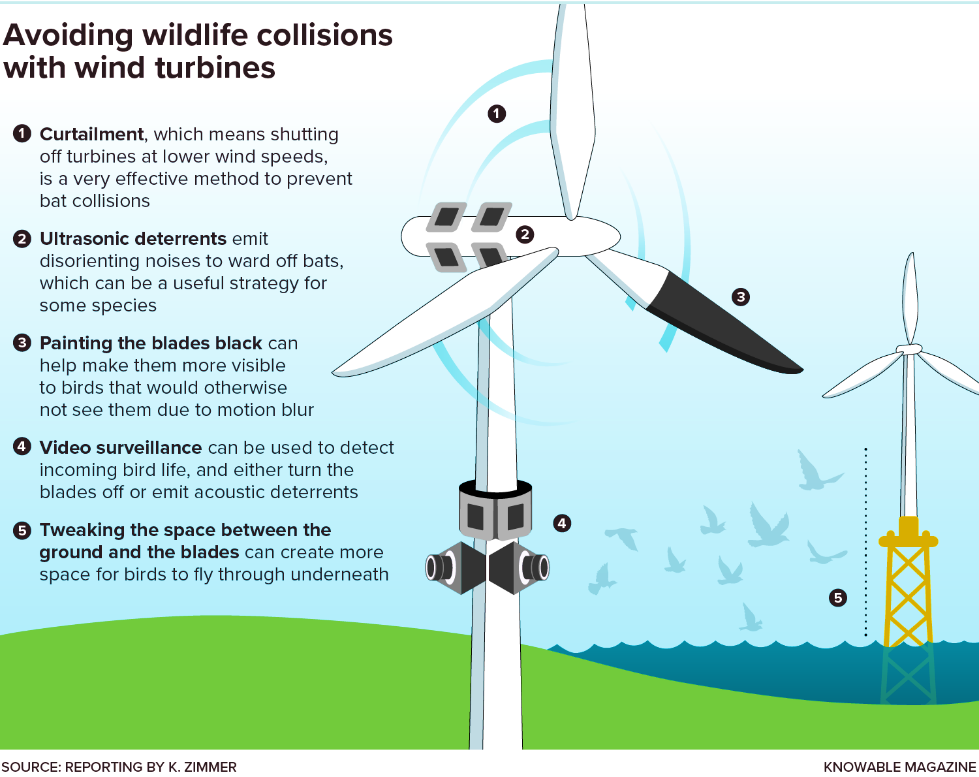
Bird & Bat Collision Mitigation : to reduce bird and bat fatalities caused by wind turbines by integrating insights from avian biology and renewable energy technology. By understanding bird flight mechanics, researchers are designing turbine blades that minimize collision risks, showcasing how interdisciplinary approaches can enhance renewable energy solutions while protecting wildlife.
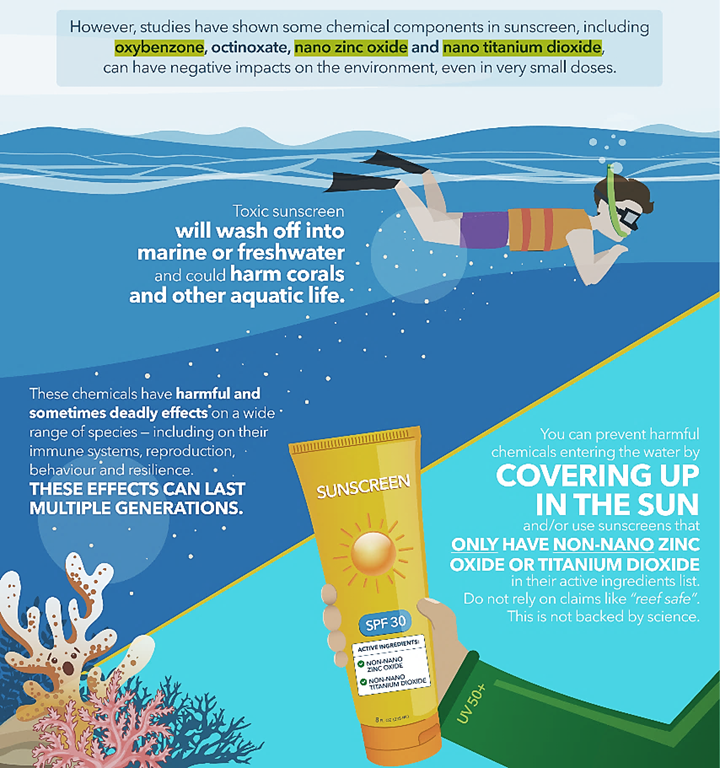
Coral-Safe Sunscreen : this project combined knowledge from chemistry, marine biology, and environmental science to create a product that protects human skin without harming marine ecosystems.
Green Infrastructure : integrates natural elements into urban planning to mitigate issues like air pollution and urban heat islands.
AI-Driven Environmental Monitoring : by combining computer science with environmental studies.
1.3 COMPONENTS OF THE ENVIRONMENT
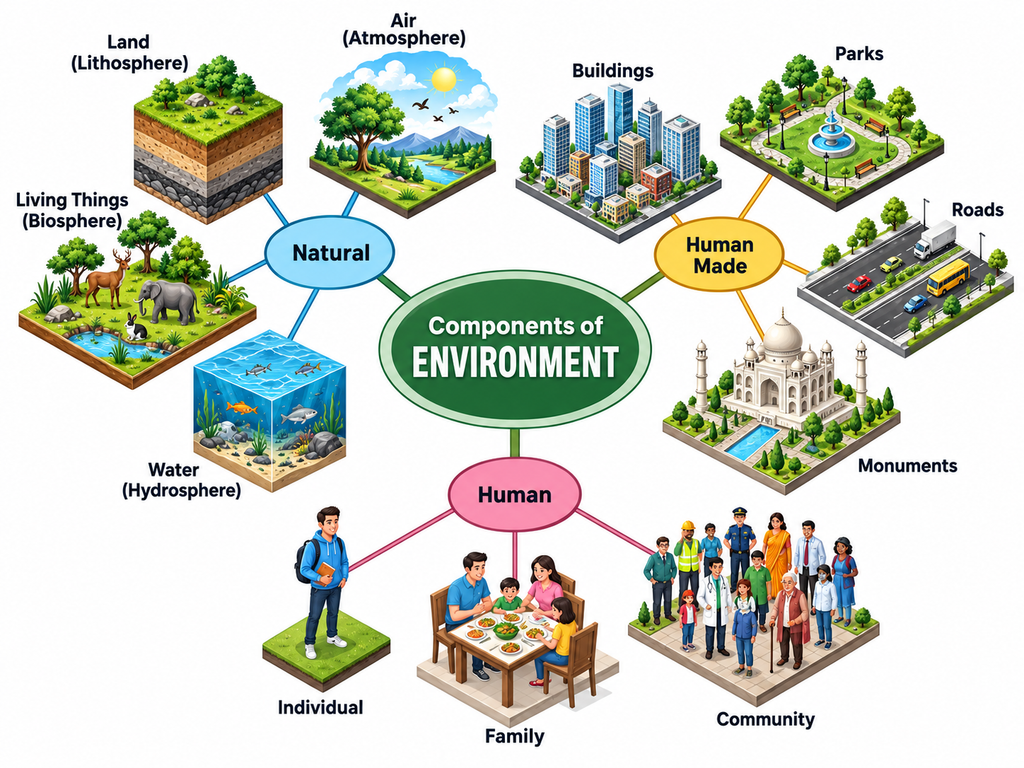
The Environment encompasses all the external conditions and factors — both living (biotic) and non-living (abiotic) — that surround and influence organisms. These components interact continuously to sustain life on Earth. Broadly, environmental components can be classified into:
• Biotic (Living) Components
• Abiotic (Non-living / Physical) Components
• Energy Component
• Cultural or Built Environment
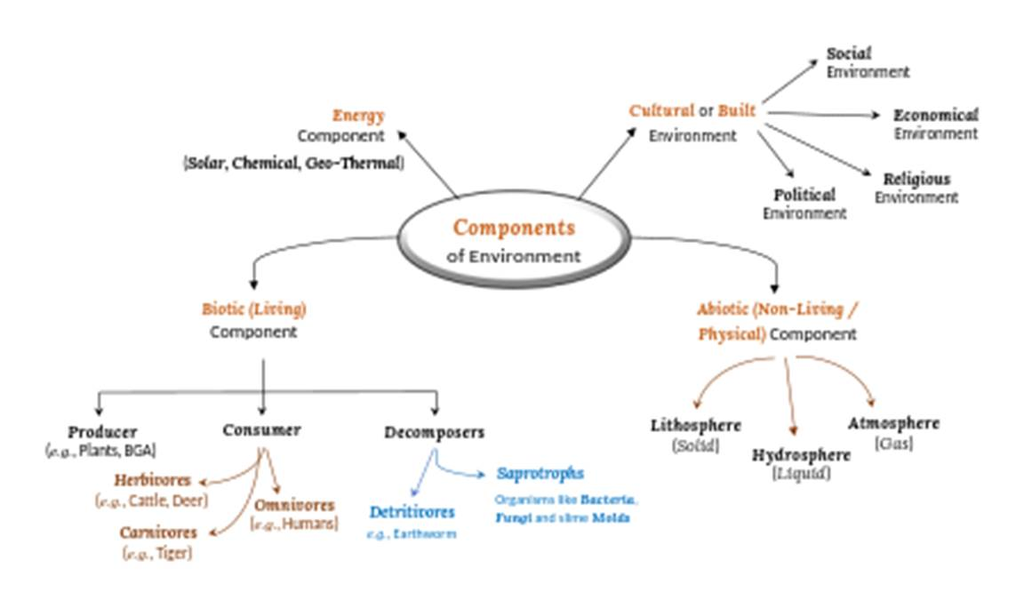
Biotic (Living) Components
Biotic components include all living organisms. They form complex, interdependent relationships within ecosystems. Based on their nutritional habits, biotic components are further categorized into —
1. Autotrophs (Producers)
Organisms that synthesize their own food from simple inorganic substances (e.g., carbon dioxide and water) using an energy source, typically sunlight (Photosynthesis).
Examples : Green plants, algae, and some bacteria (e.g., Cyanobacteria).
In regions without sunlight — such as deep-sea hydrothermal vents — certain bacteria perform Chemosynthesis by using chemical energy (often from hydrogen sulphide or methane) to produce food.
2. Heterotrophs (Consumers)
Organisms that feed on other organisms or organic matter because they cannot synthesize their own food. Heterotrophs are also called Phagotrophs because they ingest organic material.
Types
- Herbivores (Primary Consumers) : Feed directly on plants (e.g., cattle, deer).
- Carnivores : Feed on other animals.
- Secondary Consumers : Feed on herbivores (e.g., small predatory birds).
- Tertiary Consumers : Feed on secondary consumers (e.g., larger predators like tigers).
- Omnivores : Feed on both plants and animals (e.g., bears, humans).
3. Saprotrophs (Decomposers or Reducers)
Organisms (often Bacteria, Fungi and slime Molds) that break down dead or decaying organic material by secreting digestive enzymes, which convert complex compounds into simpler substances.
Detritivores, a type of decomposers, are organisms that feed on detritus, which is dead and decaying plant and animal matter, e.g., Earthworms, Dung beetles, etc.
Importance
• Nutrient Cycling : They recycle essential nutrients (nitrogen, phosphorus, carbon) back into the soil or water, making these nutrients available for plants (producers).
• Ecosystem Stability : Decomposers help in waste removal and prevent the accumulation of dead matter.
Exam Corner – Previous Year Question
Q. Components of ecosystem and biotic factors.
UPPSC ACF (Main) 2019 | Environmental Science Optional | 8 + 8 Marks
💡 Hint :
Two-part 8+8 answer. Part A (Components of ecosystem) — list all four: biotic, abiotic, energy and cultural, with a labelled mind-map. Part B (Biotic factors) — organise around the trophic classification: Autotrophs (producers, with photosynthesis & chemosynthesis), Heterotrophs (herbivores/carnivores/omnivores with cattle, deer, tigers, bears, humans as examples), and Saprotrophs (bacteria, fungi, slime molds; detritivores like earthworms & dung beetles). Close with a line on nutrient cycling & ecosystem stability.
Abiotic (Non-Living / Physical) Components
Abiotic components are the non-living physical and chemical factors that shape an ecosystem. These factors directly affect the survival, growth, and reproduction of all living organisms. Major abiotic components include Lithospheric (Solid), Hydrospheric (Liquid), and Atmospheric (Gas) elements.
Exam Corner – Previous Year Question
Q. Abiotic components of an ecosystem.
UPPSC ACF (Main) 2018 | Environmental Science Optional | 20 Marks
💡 Hint :
20-marker → structured, exhaustive answer. Open with a one-line definition. Then break abiotics into three heads — Lithospheric (soil, rocks, minerals), Hydrospheric (surface + ground water, salinity, dissolved gases), and Atmospheric (temperature, light, humidity, wind, gases). Add sub-headings for climatic factors, edaphic factors and topographic factors. Give ecological role of each with an example (e.g., soil texture → plant community; temperature → distribution of species). Conclude with a line on how abiotic factors set the LIMITS within which biotic components function.
Energy Components — Solar & Geothermal
The Sun, as the primary source of energy, drives essential ecological processes and sustains planetary systems by powering mechanisms like photosynthesis and influencing global climate patterns. On the other hand, Geothermal Energy, derived from the Earth’s internal heat, fuels natural phenomena such as volcanic activity and hydrothermal circulation, playing a crucial role in shaping Earth’s geological and ecological systems.
Cultural or Built Environment
Humans have created a variety of constructs collectively known as the cultural or built environment. These include social, economic, political, and religious components.
Interaction Between Biotic and Abiotic Components
The environment is a dynamic system where physical (abiotic) and biological (biotic) components interact continuously, driving processes essential for life. These interactions often involve complex chemical reactions that sustain ecosystems, regulate biogeochemical cycles, and maintain ecological balance.
A key example is photosynthesis, in which green plants use sunlight, water, and carbon dioxide to produce glucose and oxygen, thereby providing the primary energy source for higher trophic levels.
Photosynthesis : Conversion of Solar Energy to Chemical Energy
Plants (biological) utilize sunlight (physical), carbon dioxide (CO2), and water (H2O) to synthesize glucose, releasing oxygen (O2) as a byproduct.
6CO2 + 6H2O ⎯⎯⎯Light⎯⎯⎯➤ C6H12O6 + 6O2
Here, Physical Components — Sunlight provides energy for the reaction, CO2 is absorbed from the atmosphere, and water is sourced from the soil.
Biological Components : Chlorophyll in the plant chloroplasts captures light energy, while enzymes catalyze the conversion of CO2 and H2O into glucose.
Nutrient cycling further connects biotic and abiotic components, as saprotrophs break down organic matter into simpler substances — releasing essential elements like nitrogen, phosphorus, and carbon back into the environment — which plants then reabsorb for growth and reproduction.
(C6H10O5)n + nH2O ⎯⎯⎯Saprophytes⎯⎯⎯➤ nC6H12O6
Glucose is further oxidized to CO2 and H2O.
Lichen-Mediated Weathering : Biogeochemical Weathering
Crustose Lichens (fungi + algae) through secretion of acids to break down rocks, releasing minerals. Help in Accelerating soil formation and nutrient cycling.
⬆ Upload file: images/07_lichen_weathering.jpeg
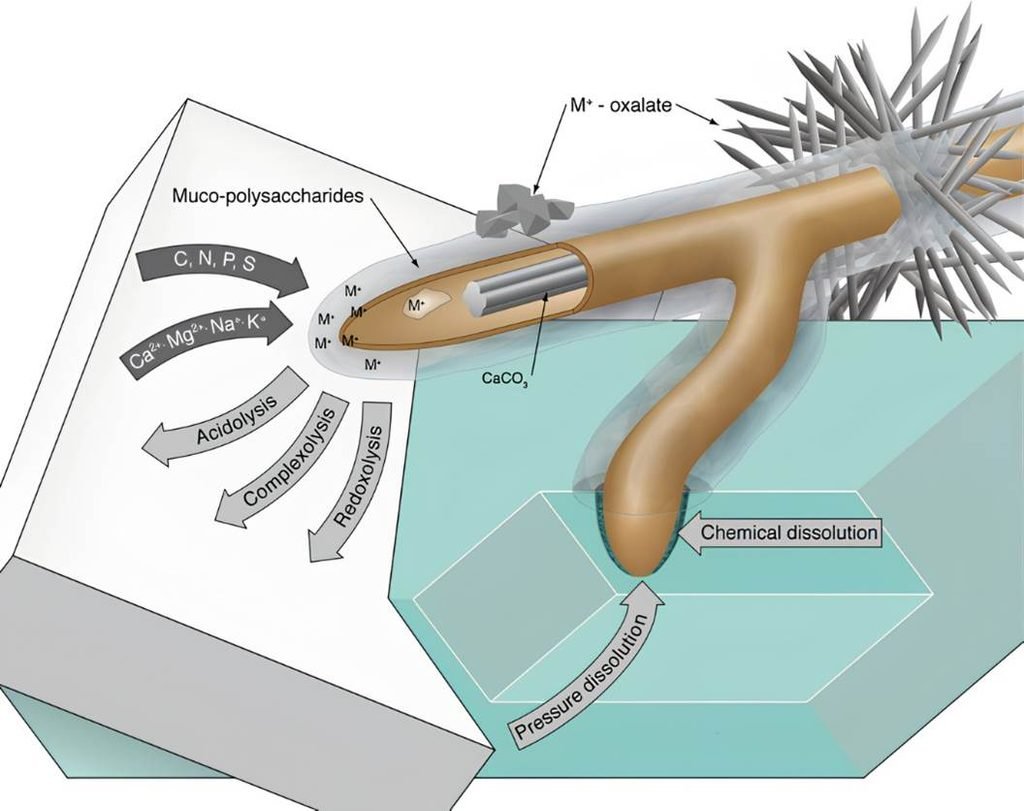
The Four Mechanisms of Biogeochemical Weathering
◈ Acidolysis is a process where the roots of plants release organic acids (H+) into the surrounding environment. These acids lower the pH of the soil, making it more acidic. As a result, this acidity helps to dissolve minerals in the rock, facilitating the absorption of nutrients by the plant.
◈ Complexolysis is a process where the roots of plants release organic compounds, such as ligands or chelating agents. These compounds bind to metal ions found in rocks, creating soluble complexes. This helps in breaking down the rocks and allows plants to access essential nutrients.
◈ Redoxolysis : The root can alter the oxidation state of elements in the rock (like iron or manganese), making them more soluble.
◈ Pressure dissolution : The physical pressure exerted by the growing root can also contribute to the breakdown of the rock, particularly at points of contact.
Nature of Interactions
Dependency : Biotic factors depend on abiotic factors for survival. For example, plants (biotic) require sunlight, water and minerals (abiotic) for photosynthesis. Conversely, biotic components can influence abiotic factors. For instance, a dense forest vegetation can affect soil quality and moisture levels through processes like transpiration and decomposition.
Energy & Minerals Flow : The flow of energy through ecosystems begins with abiotic components. Where first captured by the plants during photosynthesis, converting it into chemical energy stored in organic matter. This energy then moves through the food web as animals consume plants and each other, and when the organisms die or produce waste, nutrients are returned to the soil (abiotic), enriching it for future plant growth. This cycle illustrates how energy and nutrients move between biotic and abiotic components.
Exam Corner – Previous Year Question
Q. What are the Physical and Biological Components of environment? How do the physical and biological components of environment interact with each other? Explain with example.
Arunachal PSC ACF (Main) 2018 | Environmental Science Optional | 6 Marks
💡 Hint :
6-marker → three tight parts. (i) Physical components — lithospheric, hydrospheric, atmospheric plus energy (sunlight, geothermal). (ii) Biological components — autotrophs, heterotrophs (herbivores/carnivores/omnivores), saprotrophs. (iii) Interaction — anchor with the photosynthesis equation (6CO₂ + 6H₂O → C₆H₁₂O₆ + 6O₂) and mention nutrient cycling via saprotrophs. Bonus: mention lichen-mediated weathering (acidolysis, complexolysis, redoxolysis, pressure dissolution) as a biotic → abiotic feedback.
Q. Explain in detail the biotic and abiotic environmental factors of an ecosystem.
UK PSC RFO (Main) 2012 | Environmental Science Optional | 25 Marks
💡 Hint :
Long-form 25-marker. Structure : Introduction (2 marks) → Biotic factors detailed with trophic classification and examples like cattle, deer, tigers, bears, cyanobacteria, earthworms (8) → Abiotic factors detailed with lithospheric/hydrospheric/atmospheric split plus climatic + edaphic + topographic sub-heads (8) → Interaction with photosynthesis equation, nutrient cycling, and lichen-mediated weathering as illustrations (5) → Conclusion linking dependency and energy flow (2). Add a labelled diagram.
Q. Explain biome and ecosystem with the help of suitable diagram.
UPPSC ACF (Main) 2021 | Environmental Science Optional | 20 Marks
💡 Hint :
Cross-chapter question — biome is covered in detail in later chapters (Ecology). For the ‘ecosystem’ half, draw on this chapter: define ecosystem as the functional unit where biotic + abiotic components interact; show a labelled diagram with producers, consumers, decomposers, and abiotic inputs (sunlight, water, soil, gases). For ‘biome’, briefly define as large regional ecosystem shaped by climate (temperature + precipitation) and give 4–5 examples (tropical rainforest, desert, tundra, grassland, taiga). Add a comparison table: Ecosystem vs Biome (scale, boundaries, defining factor).
1.4 UPSC PRELIMS & MAINS RELEVANCE
For Prelims (UPSC CSE / UPPSC / State PSC):
- Definition & etymology of ‘environment’ (French Environ / Environer).
- Four components of environment – Biotic, Abiotic, Energy, Cultural / Built.
- Trophic classification – Autotrophs (Producers), Heterotrophs (Consumers), Saprotrophs (Decomposers).
- Special modes – Photosynthesis (green plants, algae, cyanobacteria) & Chemosynthesis (deep-sea vent bacteria using H₂S / CH₄).
- Detritivores (earthworms, dung beetles) as a sub-type of decomposers.
- Three shells of abiotic environment – Lithosphere (Solid), Hydrosphere (Liquid), Atmosphere (Gas).
- Interdisciplinary nature – links to biology, chemistry, physics, economics, sociology, engineering.
For Mains (Optional – Environmental Science; also GS-III):
- ‘Environmental science is interdisciplinary’ — classic 4–10 mark question; use the climate-change mapping.
- Photosynthesis equation with subscripts + role of chlorophyll and enzymes.
- Nutrient cycling via saprotrophs — link back to ecosystem stability and soil fertility.
- Biogeochemical weathering by lichens — the four mechanisms (Acidolysis, Complexolysis, Redoxolysis, Pressure Dissolution).
- Innovative interdisciplinary solutions — bird & bat collision mitigation, coral-safe sunscreen, green infrastructure, AI-driven monitoring.
- GS-III linkages — conservation of biodiversity, sustainable development, climate change mitigation & adaptation.
1.5 KEY TAKEAWAYS – ONE-GLANCE REVISION
✔ ‘Environment’ = sum of all external conditions (physical, chemical, biological, social, cultural) that influence an organism’s growth, development and survival. Word derived from French Environ / Environer, meaning ‘to surround’.
✔ Environmental science is INHERENTLY interdisciplinary — integrates biology, chemistry, physics, sociology, economics, engineering.
✔ Four components of environment: Biotic + Abiotic + Energy + Cultural / Built.
✔ Biotic trophic classes: Autotrophs (Producers) → Heterotrophs / Phagotrophs (Consumers) → Saprotrophs (Decomposers). Detritivores (earthworms, dung beetles) are a sub-type.
✔ Autotrophs make food via Photosynthesis (sunlight) or Chemosynthesis (chemical energy, e.g., H₂S, CH₄ at deep-sea vents).
✔ Abiotic components = Lithospheric (Solid) + Hydrospheric (Liquid) + Atmospheric (Gas).
✔ Energy component = Solar (drives photosynthesis, climate) + Geothermal (drives volcanism, hydrothermal circulation).
✔ Photosynthesis is the flagship biotic × abiotic interaction: 6CO₂ + 6H₂O → C₆H₁₂O₆ + 6O₂ (light energy).
✔ Lichen-mediated weathering happens via four mechanisms: Acidolysis, Complexolysis, Redoxolysis, Pressure Dissolution.
✔ Dependency + Energy & Minerals Flow are the two main ‘natures of interaction’ examiners test.