Environment: Meaning, Definitions, Scope and Importance
1.1 INTRODUCTION
Contents / Index
The environment refers to everything that surrounds a living organism—people, places, objects, and phenomena—whether natural or man-made.
In the early stages of human history, the environment was perceived only in terms of physical elements such as land, air, water, and living organisms. Over time, as society evolved, the concept of environment expanded to include social, economic, and political dimensions as well.
Definition :The environment is the sum of all external conditions surrounding an organism, including complex physical, chemical, and biological factors, as well as social and cultural conditions, that influence its growth, development, and survival.
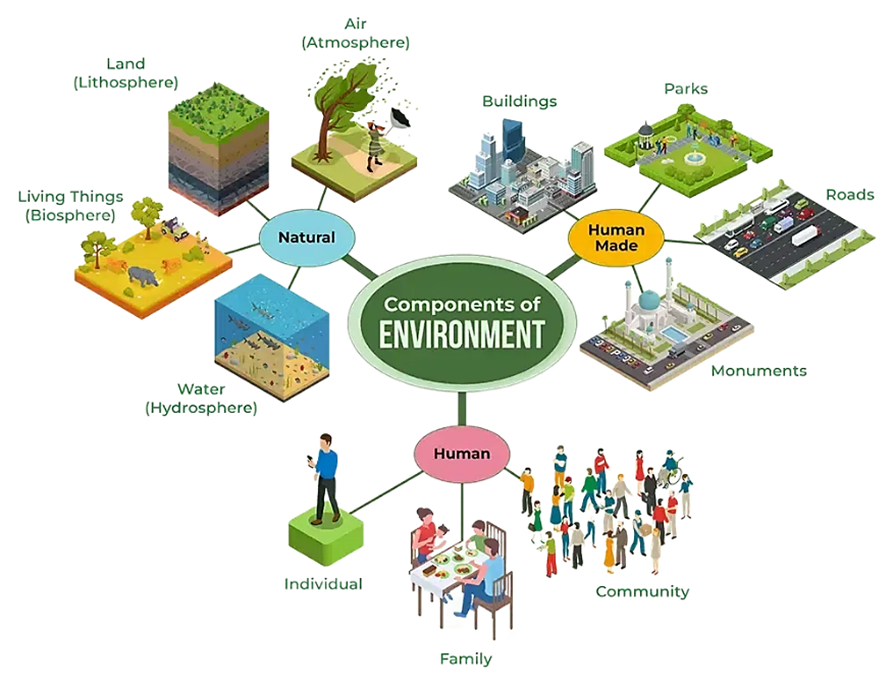
The word “environment” is derived from the French term Environ or Environer, meaning ‘to surround’.
| Exam Corner / Previous Year Question |
|---|
| Q. Definition, Meaning and Importance of study of environmental sciences Source: [UPPSC ACF (Main) 2021, Envt. Science Optional, 8 M]. Hint : For 8 marks, divide the response into definition/meaning and importance. Use the chapter’s ecosystem dynamics, resources, pollution control and conservation points; keep each explanation concise. |
1.2 SCOPE / IMPORTANCE OF ENVIRONMENTAL SCIENCE
Importance highlights the “why” – why environmental science is crucial for our well-being and the planet’s health. Scope emphasizes the “what” – what are the different areas and issues environmental science deals with.
Scope
- Understanding Natural Processes :This involves studying how natural systems function, including ecosystems, climate patterns, and geological processes.
- Human-Environment Interaction : Environmental science examines how human activities affect the environment, including land use changes, pollution, and resource consumption.
- Impact Assessment : It assesses the consequences of human actions on natural systems and seeks to measure and predict these impacts.
Importance
- Ecosystem Dynamics : This area focuses on understanding the mechanisms of ecosystems, including organism interactions, energy flow, and nutrient cycling. It aims to elucidate how these systems maintain balance and respond to changes.
- Natural Resources Management : This involves the study of how resources such as water, soil, forests, and minerals are distributed, managed, and conserved to ensure their sustainability for future use.
- Pollution Control : Here, the focus is on identifying pollution sources, understanding its environmental and health impacts, and developing strategies for prevention, treatment, and remediation of pollution in air, water, and soil.
- Climate Change Science : This encompasses research into the drivers of climate change, its global effects, and the development of strategies for mitigation (reducing greenhouse gas emissions) and adaptation (adjusting to climate impacts).
- Biodiversity Conservation : This discipline is dedicated to the protection of species diversity, habitats, and ecosystems, emphasizing the importance of biodiversity for ecological stability and human well-being.
- Environmental Policy and Legislation : It involves the creation, analysis, and enforcement of laws and policies aimed at protecting the environment. This includes international agreements, national laws, and local regulations.
- Human-Environment Interaction : This aspect examines how human activities influence the environment, assessing impacts like urbanization, industrialization, and agriculture, and devising methods to reduce negative environmental footprints.
- Sustainability Practices : This field explores sustainable development principles, aiming to harmonize economic growth, social development, and environmental protection to ensure that current human needs are met without compromising future generations’ resources.
| Exam Corner / Previous Year Question |
|---|
| Q. Scope and Importance of environmental science Source: [UPPSC ACF (Main) 2018, Envt. Science Optional, 20 M]. Hint : For 20 marks, divide the answer into scope (three source points) and importance (eight source points). Develop each point, using a compact scope–importance comparison to organise the response. Q. Define environment. Write down the Importance and Scope of environmental science. Discuss briefly on socio-economic causes of environmental degradation. Source: [Odisha PSC Forest (Mains) paper – I | 2015 |20 M]. Hint : For 20 marks, divide the answer into definition, importance, scope and socio-economic causes. The last part is asked in the PYQ but is not separately explained in the source; supplementary study material is required. |
Definition :
The environment encompasses all living and non-living things occurring naturally on Earth or some region thereof. It is an interconnected system where living organisms interact with each other and with the physical and chemical components of their surroundings, influencing their growth, development, and survival. These interactions are essential for maintaining the balance and sustainability of life on Earth.
Quick Revision
- Environment: natural and man-made surroundings; physical, chemical, biological, social and cultural conditions.
- Scope: understanding natural processes, human-environment interaction and impact assessment.
- Importance: ecosystem dynamics and natural resources management.
- Pollution control, climate change science, biodiversity conservation and environmental policy.
- Human-environment interaction and sustainability practices connect social and ecological concerns for long-term human well-being.
Conclusion
The environment influences the growth, development and survival of organisms. Environmental science examines natural processes, human impacts and the management of resources, while its importance extends to pollution control, biodiversity conservation, environmental policy and sustainability practices.