
All living things need energy to live, grow, move, repair their bodies, and reproduce. The main source of this energy is the Sun. Green plants use sunlight to make their own food through a process called photosynthesis. They change sunlight into energy stored in food (glucose). Animals and other living things eat plants or other animals to get this stored energy. As energy moves from one living thing to another, some energy is lost at each step. This movement of energy from the Sun through plants and animals is called the flow of energy in an ecosystem.
Sun → Plants → Animals
Definition : Energy flow refers to the movement of energy from one organism or trophic level to another within an ecosystem. It starts with producers (like plants) capturing energy from sunlight and then passes through consumers (like animals) as they eat each other. A lot of energy is lost as heat at each step.
Primary production and respiration
Contents / Index
When green plants make their own food, some of it is used by the plants themselves for energy. This happens through a process called respiration, where the food is broken down inside their body, releasing energy and carbon dioxide (CO₂).
The total amount of food produced by plants is called Gross Primary Production (GPP). But after using some of this food for respiration (R), plants are left with less food. The remaining food is called Net Primary Production (NPP).
NPP = GPP – R
Ingestion and assimilation
When a rabbit eats plants, this process is called Ingestion. Some of the food the rabbit eats is used by its body to build new cells and tissues. This useful part of food is called Assimilation. However, not all food eaten by the rabbit can be used. The leftover part that cannot be used, such as tough parts of stems or roots, leaves the rabbit’s body as waste. This waste removal is called Excretion.
Source-review note: The source calls removal of undigested food “Excretion” and uses the same term in its assimilation equation. Original terminology is retained for review, not silently corrected.
We can calculate assimilation with this simple equation:
Assimilation = Ingestion – Excretion
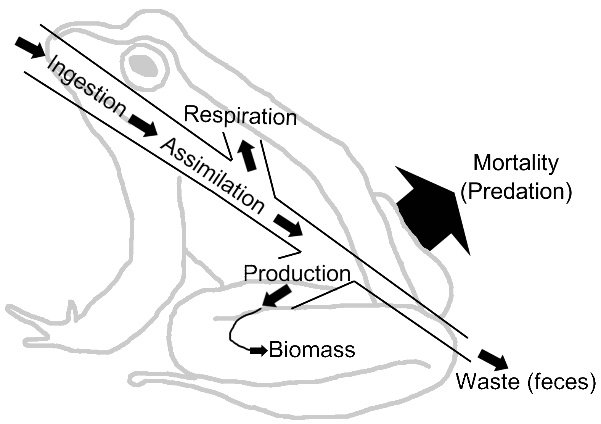
Different organisms have different efficiency to assimilate food. Animals eating plants (herbivores) can assimilate about 15–50% of the food they eat. Animals eating other animals (carnivores) usually assimilate about 60–90%.
Respiration and secondary production
When the rabbit uses the assimilated energy, a big part of it goes into normal body activities like keeping warm, breathing, and making proteins. This energy is used through a process called Cellular Respiration and is lost from the rabbit’s body as heat. Only the remaining energy is used by the rabbit to grow bigger or produce babies.
When a fox eats the rabbit, the fox only gets the energy stored in the rabbit’s body (growth and reproduction). This leftover energy, available for animals like foxes, is called the rabbit’s Secondary Production. Clearly, rabbits use most of the energy they get, so foxes get less energy from rabbits compared to what rabbits got from plants.
During each transfer of energy from one trophic level to the next, the quantity of energy decreases by about 90% at each step, but the quality (per unit mass) becomes higher. This one-way flow of energy is governed by the Principles of Thermodynamics.
Source-review note: The source states about 90% loss at each step and an increase in quality per unit mass; later it gives a 5–30% transfer range. The original qualifications and figures are retained.
Why energy flow matters
Essential to understand the efficiency of producer in absorption and conversion of solar energy.
Balances Nature : If tigers vanish in Ranthambore, deer overgraze, destroying forests. Energy flow keeps populations in check.
Short Food Chains : Most ecosystems have 3–4 steps. For example, in Kazi Ranga, Grass → Rhinos → Tigers (only 3 trophic levels).
Source-review note: The original Kaziranga Grass → Rhinos → Tigers example and 3–4-step statement are retained. A later passage states four or five levels; the scope is not reconciled in the notes.
No Recycling : Unlike nutrients (e.g., compost), energy isn’t reused. Forests need constant sunlight to survive.
Why energy cannot return
In contrast to the cyclical nature of nutrient flows, energy flows are linear and do not return to their original source within the ecosystem. This unidirectional characteristic imposes a limitation on the number of trophic levels that an ecosystem can support. At each transfer of energy from one level to the next, a significant portion is lost, primarily as heat, respiration, excretion, etc. thus reducing the amount of energy available for the subsequent levels.
First law of thermodynamics
This law states that energy cannot be created or destroyed, only transformed. In an ecosystem, solar energy captured by plants through photosynthesis is converted into chemical energy stored in biomass (like leaves and wood). Animals consuming these plants convert this stored chemical energy into mechanical energy for movement and heat energy during metabolic processes.
The total amount of energy entering the system as sunlight equals the energy leaving the system through heat loss, although it may undergo numerous transformations as it flows through the biotic and abiotic components.
Source-review note: The source equates incoming sunlight with outgoing heat without specifying the time interval or energy-storage condition. Wording is retained.
Second law of thermodynamics
The Second Law of Thermodynamics introduces the concept of energy quality and states that whenever energy is transformed from one form to another, some energy is inevitably lost as heat to the surroundings. This law explains why no energy transfer or transformation in the real world is perfectly efficient; a portion of the initial usable energy is always converted into a less usable form, primarily heat. This principle is fundamental to understanding the decrease in available energy as one moves up through the trophic levels of an ecosystem.
The ecological efficiency, which is the amount of energy transferred from one trophic level to the next, typically ranges from 5% to 30%, with an average of around 10%. This inefficiency is largely due to the energy expended by organisms in metabolic processes, including respiration, which generates heat. Ultimately, all the energy that flows through a food chain is eventually lost from the ecosystem as heat energy.
Implications for ecosystems
The First Law dictates that energy is conserved, meaning it is neither created nor destroyed, but merely transformed. The Second Law introduces the constraint that these transformations are never perfectly efficient, with some energy being lost as heat at each step. Together, these laws govern the unidirectional movement of energy and the progressive loss of energy as it travels through the food web.
Because energy cannot be recycled within ecosystems in the same way that matter can. Therefore, ecosystems need constant new energy, usually from the sun, to sustain their functions.
This loss of energy also explains why food chains usually have only four or five levels. Beyond that, there isn't enough energy left to support higher-order consumers.
Due to this, fewer animals can live at the top of food chains, limiting how complex an ecosystem can become.
The Second Law also imposes limits on the complexity and the carrying capacity of ecosystems. The progressive loss of usable energy at each trophic level restricts the number of organisms that can be supported at higher levels and the overall complexity of the food web.
Questions from the chapter
What is ecosystem energetics? Describe the energy flow in a typical ecosystem.
Write a note on – Energy flow in an ecosystem [UPPSC Forest (Main) 2018, 2021; Environmental Science Optional, 8 M].
Energy flow in terrestrial ecosystem [UPPSC Forest (Main) 2017, Environmental Science Optional, 20 M].
Write a note on – Energy transfer in ecosystem with an example [Himachal PSC RFO (Main) 2017, Environmental Science Optional, 15 M].
Exam attributions are reproduced from the supplied notes; unattributed questions remain unattributed.
Chapter 6 reading order
- Energy Flow in Ecosystems: Processes and Thermodynamic Laws
- Energy Flow Models: Single Channel, Y Shaped and Universal
- Biomass: Types, Accumulation and Energy Uses in India
- Ecosystem Productivity: Primary, Secondary and Influencing Factors
- Methods of Measuring Primary Productivity
- Primary Productivity Patterns in Terrestrial and Aquatic Ecosystems