
The atmosphere and hydrosphere interact through complex cycles of water, heat, and gas exchange, which are critical for weather regulation, climate stability, and biogeochemical processes.
Contents / Index
Hydrological cycle
Hydrological (Water) Cycle : The continuous exchange of water between the atmosphere and hydrosphere drives global weather patterns and freshwater distribution.
The sun heats water in oceans, lakes, and rivers, causing it to evaporate into the air as water vapor. This process transfers latent heat to the atmosphere, influencing cloud formation. This cycle is vital for replenishing fresh water and regulating weather patterns.
Heat storage and distribution
Heat Storage & Distribution : Oceans act as thermal regulators, moderating global temperatures through heat absorption and redistribution.
Thermohaline circulation
Thermohaline Circulation : Density-driven currents (e.g., Gulf Stream) redistribute heat from tropics to poles, stabilizing regional climates (e.g., Europe’s mild winters).
Original-source note: The current and regional-climate example follow the original wording.
El Niño–Southern Oscillation
El Niño-Southern Oscillation (ENSO) : Periodic warming (El Niño) or cooling (La Niña) of Pacific Ocean surfaces disrupts global weather, causing floods, droughts, or intensified hurricanes.
Biogeochemical cycles
Biogeochemical Cycles : The exchange of gases and nutrients sustains ecological balance and climate regulation.
Carbon cycle
Carbon Cycle : Oceans absorb ~30% of anthropogenic CO₂, forming carbonic acid and reducing atmospheric warming. However, this leads to Ocean Acidification, threatening marine ecosystems (e.g., Coral Bleaching).
Original-source note: The coral-bleaching example is retained as stated in the original notes.
Nutrient cycles and upwelling
Nutrient Cycles (Upwelling) : Cold, nutrient-rich waters rise to surface layers, boosting marine productivity and influencing atmospheric CO₂ levels through phytoplankton blooms.
Feedback mechanisms
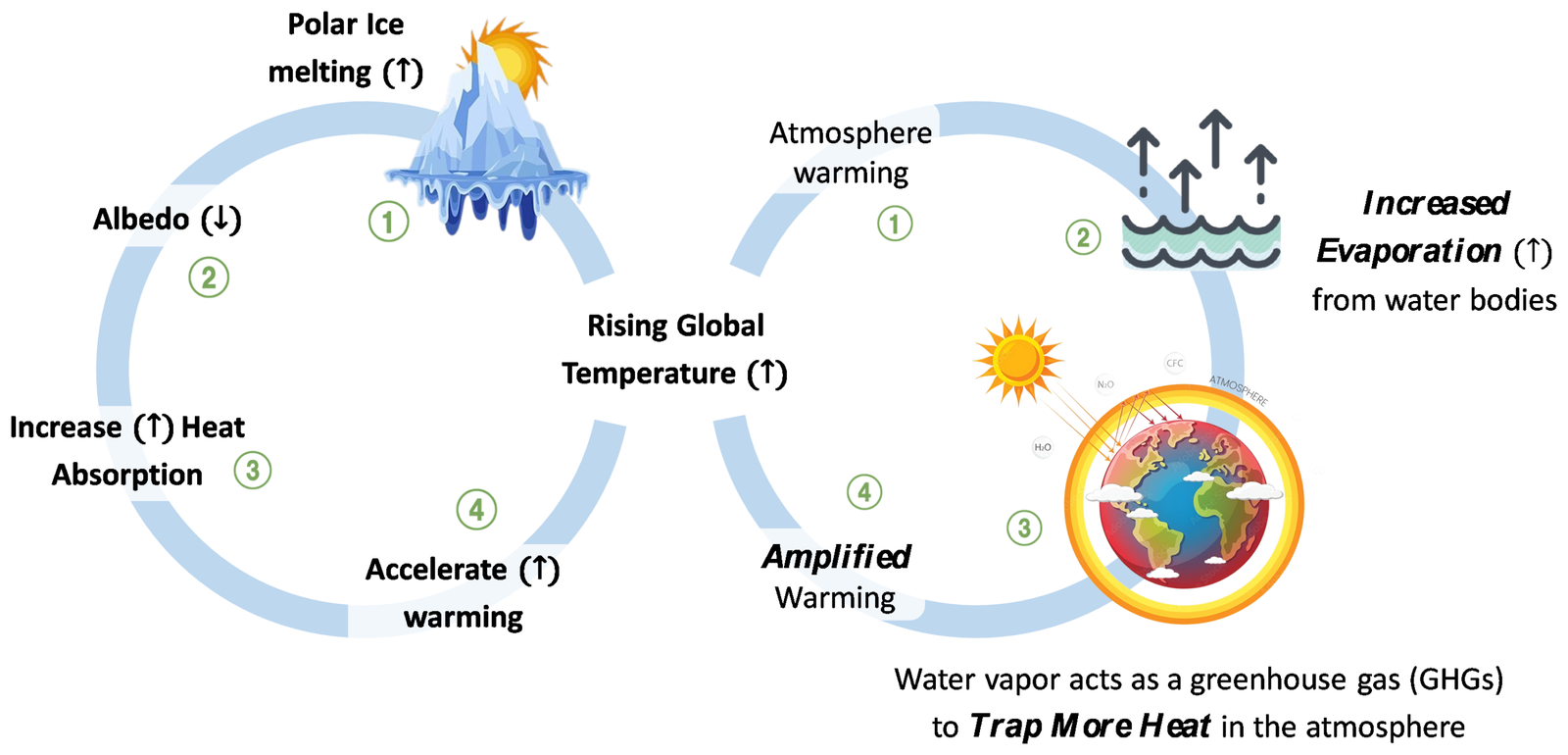
Feedback Mechanisms : Interactions between the two spheres amplify or mitigate climate change.
Water-vapour feedback
Water Vapor Feedback : A warmer atmosphere holds more water vapor (a potent greenhouse gas), enhancing the greenhouse effect and creating a Positive Feedback Loop.
Ice-albedo feedback
Ice-Albedo Feedback : Melting polar ice reduces Earth’s reflectivity (albedo), increasing heat absorption and accelerating warming.
Questions from the chapter
Discuss briefly the process of interactions between atmosphere and hydrosphere [Arunachal PSC ACF (Main) 2012; Environmental Science Optional, 5 M]
Exam attributions follow the supplied chapter.
Quick revision
- The atmosphere and hydrosphere exchange water, heat and gases.
- Oceans store and redistribute heat.
- Upwelling brings nutrient-rich water to surface layers.
- Water-vapour and ice-albedo feedbacks can amplify warming.
Related concepts from earlier chapters
Related topics
- Hydrosphere: Meaning, Hydrology and Components
- Hydrosphere and Geosphere: Weathering, Groundwater and Water Quality
- Biosphere: Meaning and Abiotic, Biotic and Energy Components
Chapter 3 index
- Hydrosphere: Meaning, Hydrology and Components
- Atmosphere and Hydrosphere Interactions: Water, Heat and Feedbacks
- Hydrosphere and Geosphere: Weathering, Groundwater and Water Quality
- Lithosphere: Composition and Oceanic–Continental Comparison
- Biosphere: Meaning and Abiotic, Biotic and Energy Components