
Ecosystems are complex networks through which energy flows from the sun, moves through living organisms, and ultimately returns to the environment. To better understand this energy flow, Lindeman (1942) introduced what is often called the Single Channel Energy Flow Model in his work on trophic dynamics. To address the limitations of Lindeman’s model, E. P. Odum proposed the Double Channel or Y-Shaped Energy Flow Model, highlighting separate pathways for grazing (herbivory-based) and detritus (decomposer-based) food chains. Later, H. T. Odum developed what is commonly referred to as the Universal Energy Flow Model, a more general framework for describing energy dynamics in ecological systems.
Source-review note: Attribution differs within the original: this overview assigns the double-channel model to E. P. Odum and universal model to H. T. Odum; subsequent headings assign them oppositely. No attribution has been silently selected.
Single channel energy flow model
Contents / Index
Single Channel Energy Flow Model : Proposed by Lindeman*** (1942)
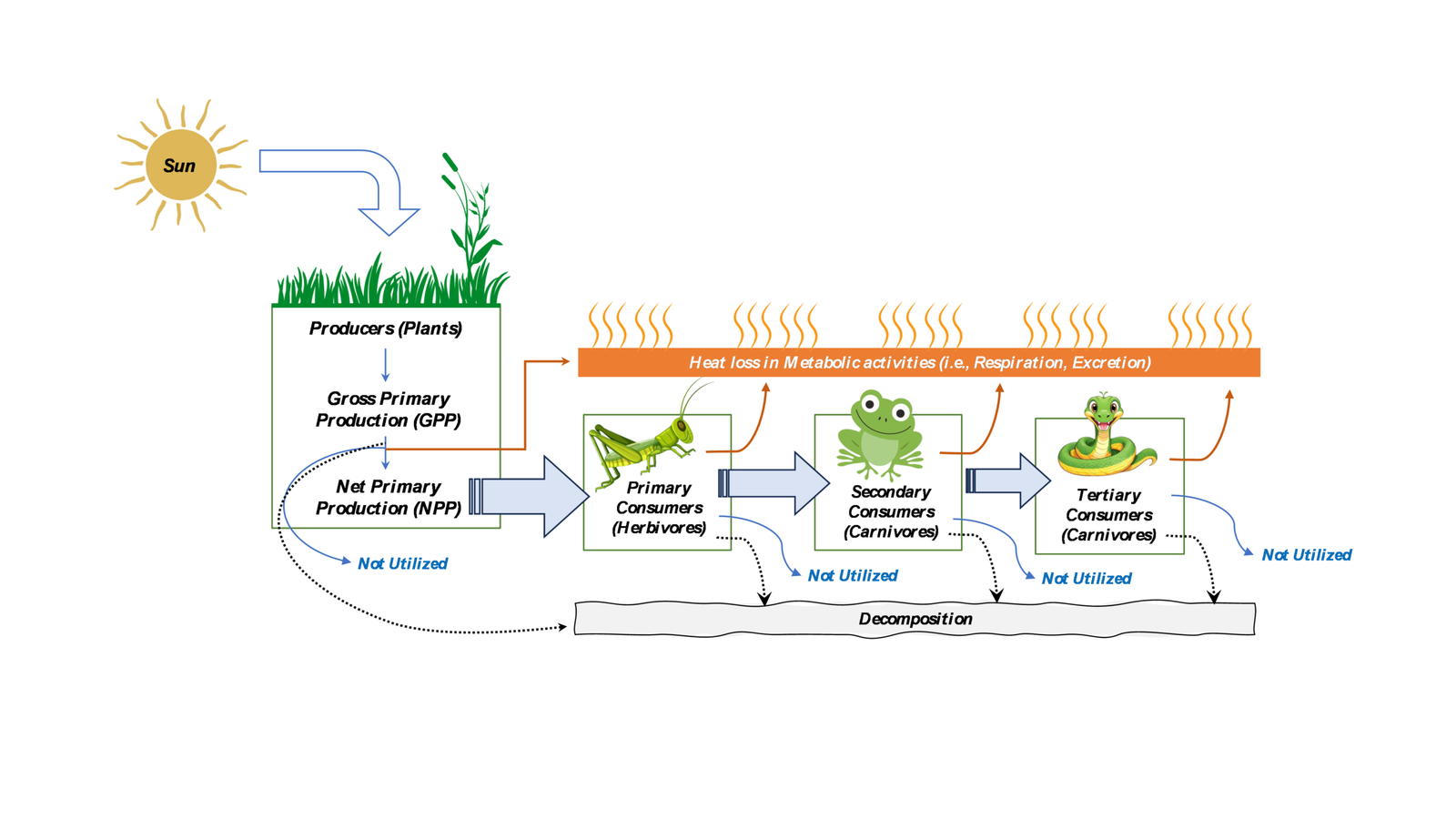
This model emphasizes the Unidirectional or One-Way Flow or Single Channel Flow of energy from producers (plants) to herbivores and then to carnivores.
Unlike nutrients (such as carbon, nitrogen, phosphorus, and sulphur) that cycle repeatedly through ecosystems, energy does not cycle back.
Once energy moves through the food chain, it cannot be reused. At each step or trophic level (Producer → Herbivore → Carnivore), approximately 90% of energy is lost. These losses happen because organisms use energy for breathing (respiration), producing heat, and other metabolic processes.
Limitations of the single channel model
Oversimplification : Real feeding relationships aren’t strictly linear. Most organisms have multiple prey and create complex food webs.
It neglects Multiple Pathways and Feedback Loops : Ecosystems often have “loops” where energy or nutrients can cycle back (e.g., detrital loops or feedback from predators to resources), but this linear model doesn’t capture them.
Source-review note: The wording about energy cycling back conflicts with the chapter’s one-way energy-flow statements. This original sentence remains for source review.
Ignores the Role of Decomposers : Bacteria, fungi, and detritivores, which recycle nutrients, are often excluded from the model.
Assumes Uniform Energy Transfer : Actual energy transfer varies widely among species and trophic levels, unlike the single, constant rate often assumed.
Double channel or Y shaped model
Double channel (Y – Shaped) Energy flow Model : by H.T. Odum***
Source-review note: This source heading attributes the double-channel model to H.T. Odum, unlike the overview. Attribution remains unresolved.
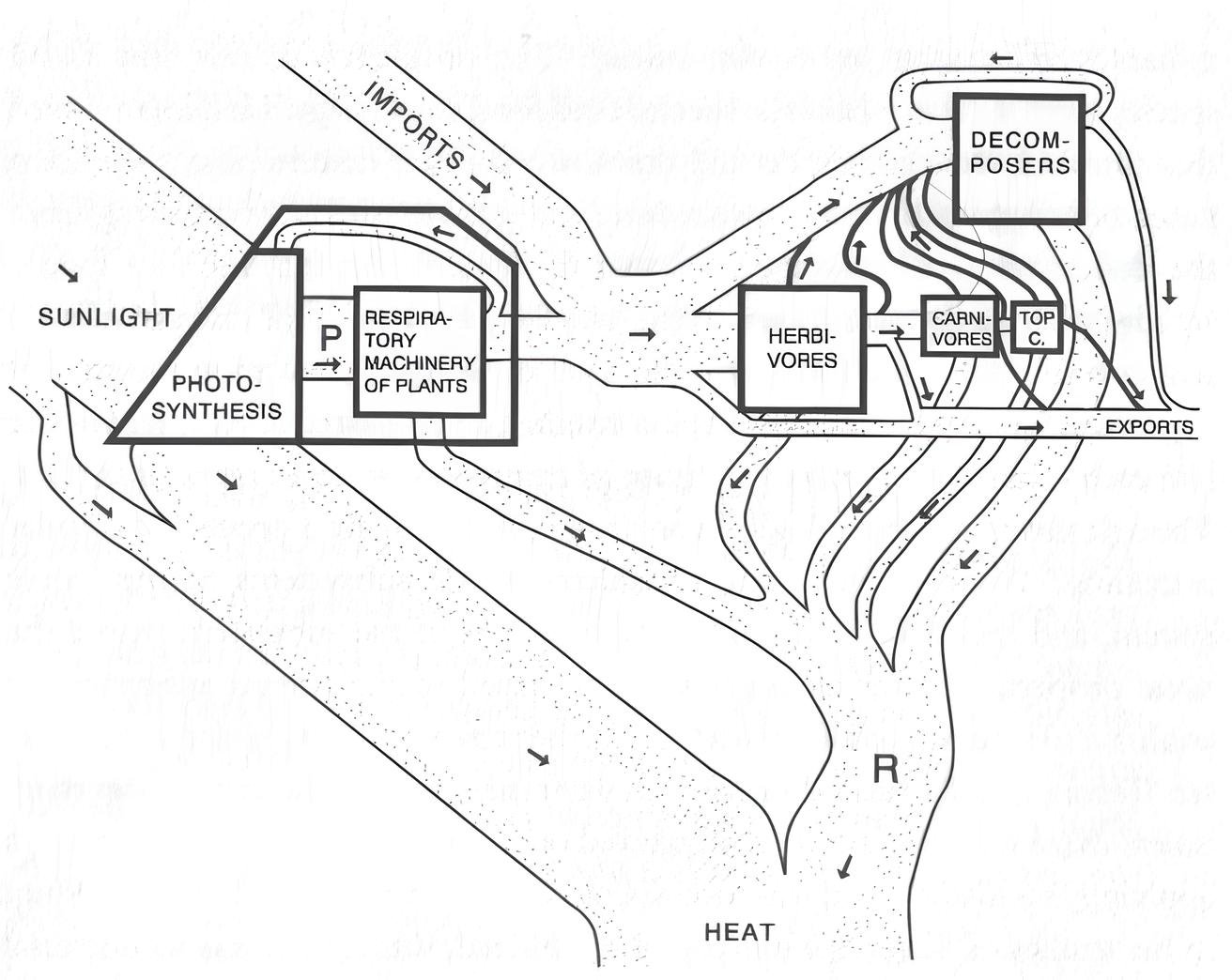
It describing how energy flows through an ecosystem via two parallel but interconnected channels— one driven by grazing (living consumers) and another driven by decomposition (detritus). This model helps us understand how ecosystems stay balanced and recycle nutrients.
The two pathways
Grazing food chain
Sun → Plants (producers) → Herbivores (e.g., deer) → Carnivores (e.g., wolves)
Grazing pathway features
Focuses on energy transfer between living organisms.
This channel often dominates in ecosystems like grasslands or shallow lakes because herbivores quickly consume most of the plant matter.
Source-review note: The scope of “most of the plant matter” and dominance across grasslands/shallow lakes is not further specified in the supplied notes.
Detritus food chain
Dead leaves/wood/waste → Decomposers (fungi, bacteria) → Detritivores (earthworms, beetles) → Predators (e.g., birds eating insects).
Detritus pathway features
Processes dead organic matter.
Dominates in forests, deep oceans, and soil-rich ecosystems, as plant material and other organic matter often accumulate and decompose over time rather than being immediately consumed by herbivores.
Connections between pathways
Shared Energy Source : Both chains start with energy from the sun (captured by plants).
Interdependence : Energy and matter can shift between grazing and detritus chains. For example, plants that are not eaten by herbivores eventually become detritus, which is then broken down by decomposers. Nutrients from this decomposition return to the soil, supporting new plant growth. This cycling of matter is crucial for maintaining ecosystem balance.
Separate in Time/Space : Grazing happens quickly (e.g., a deer eating grass), while decomposition can take weeks or years.
Macroconsumers (herbivores/carnivores) and microconsumers (decomposers) differ in size, metabolism, and ecological roles
Why a Y shape
Odum’s model is described as Y-shaped because these two channels—grazing and detritus—run in parallel but sometimes join or influence each other, much like the arms of a “Y” merging into a single stem. Ultimately, nutrients and energy in both channels support the ecosystem’s food webs and maintain the continuous cycle of energy flow.
Source-review note: The original phrase “continuous cycle of energy flow” differs from the chapter’s non-recycling explanation. Original wording is retained for review.
Importance of the detritus pathway
High Energy Processing : In many ecosystems—such as forests and oceans—the detritus channel often processes more than 90% of total primary production. This occurs because plant material and other organic matter tend to accumulate and decompose over time, rather than being immediately consumed by herbivores.
Source-review note: The original more-than-90% statement is retained; its ecosystem boundaries and measurement basis are not supplied.
Nutrient Cycling : Decomposers return vital nutrients to the soil or water, which plants then reuse, supporting soil fertility and overall ecosystem stability.
Ecosystem Storage and Delayed Consumption : By breaking down dead material slowly, the detritus chain allows energy and nutrients to be stored in the ecosystem for later use. This “delayed consumption” can promote greater structural complexity and biodiversity.
Helps in understanding ecosystem stability and nutrient recycling.
Applications
Composting : Mimics the detritus chain to recycle kitchen waste into fertilizer.
Deforestation Impact : Removing trees disrupts detritus pathways, reducing soil fertility.
Universal energy flow model
Universal Energy Flow Model : Developed by E.P. Odum (1983)
Source-review note: This source heading attributes the universal model to E.P. Odum (1983), unlike the overview. No external attribution check has been added.
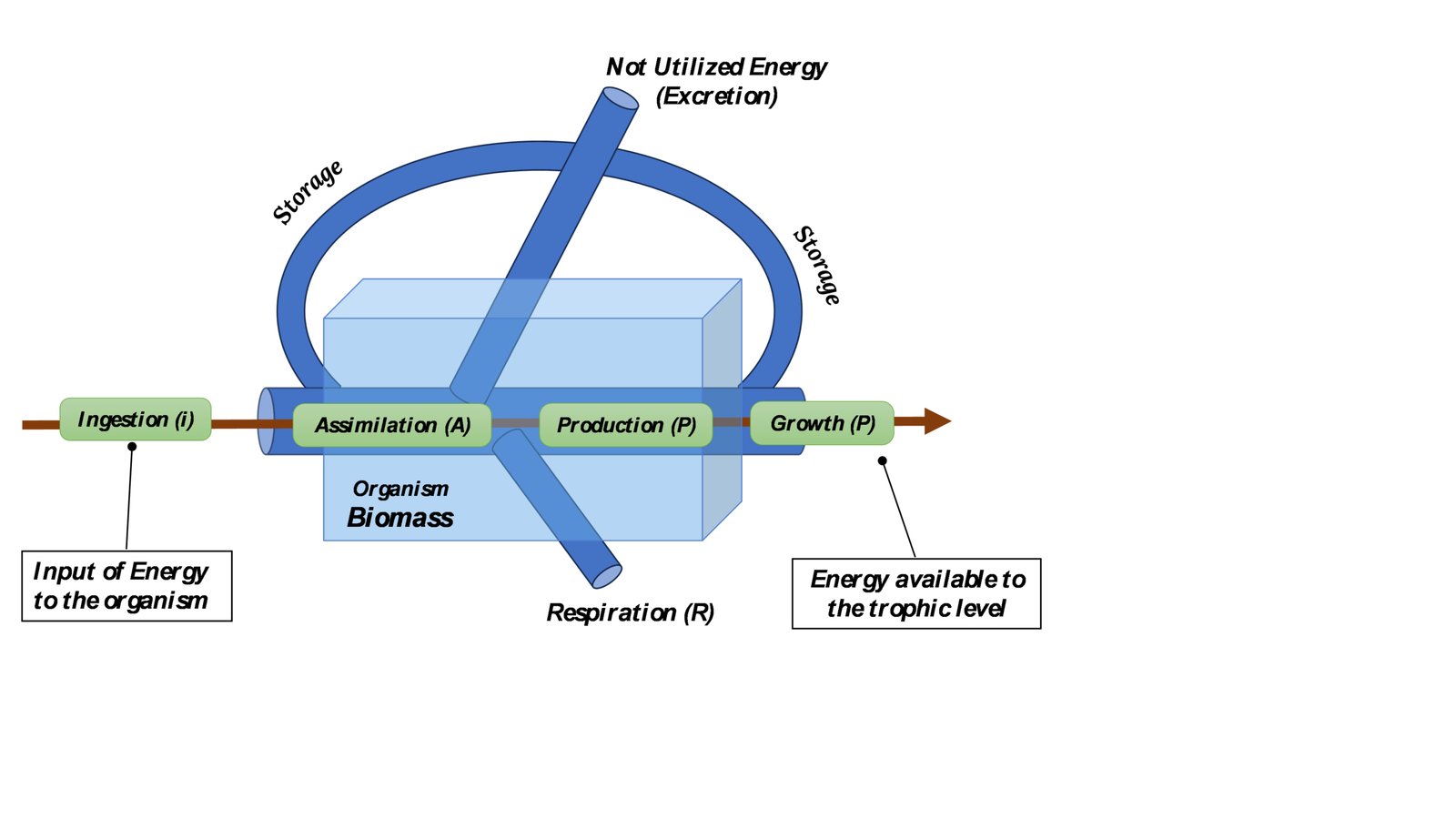
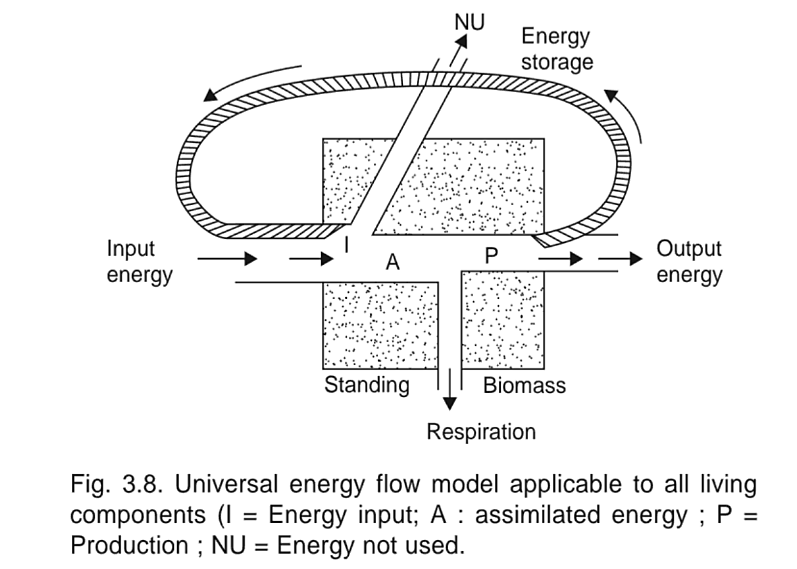
It provides a comprehensive framework for analysing energy transfer in ecosystems at any organizational level, from individual organisms to entire trophic groups.
Model components
Energy intake (I) : Total energy ingested or absorbed, varying by organism type (e.g., sunlight for autotrophs, organic matter for heterotrophs).
Assimilation (A) : Portion of intake converted into usable energy.
Production (P) : Energy stored as biomass or transferred to higher trophic levels.
Respiration (R) : Energy lost as heat during metabolic processes.
Non-utilized energy (NU) : Undigested matter (e.g., faeces) diverted to detritus pathways.
It integrates thermodynamic principles and tracks energy transformations systematically. Highlights energy storage (shaded boxes) and losses (heat), aligning with thermodynamics.
Questions from the chapter
Write notes on – Y shaped energy flow model
Exam attributions are reproduced from the supplied notes; unattributed questions remain unattributed.
Chapter 6 reading order
- Energy Flow in Ecosystems: Processes and Thermodynamic Laws
- Energy Flow Models: Single Channel, Y Shaped and Universal
- Biomass: Types, Accumulation and Energy Uses in India
- Ecosystem Productivity: Primary, Secondary and Influencing Factors
- Methods of Measuring Primary Productivity
- Primary Productivity Patterns in Terrestrial and Aquatic Ecosystems