
A habitat is the natural environment in which an organism, or a population of organisms, resides, performing activities crucial for its survival and reproduction. Often described metaphorically as the organism’s ecological "address,"
A habitat provides essential conditions for life, such as food, water, shelter, protection, and opportunities for mating.
Components of a habitat
Contents / Index
A habitat isn't just a random patch of land or water. It's characterized by a specific combination of biotic (living) and abiotic (non-living) factors that make it suitable for a particular species in Survival, Food, Shelter, Protection, and Mating. For example, a species might live in a deciduous forest, a swamp, or a grassy field.
Abiotic factors
Water availability : Crucial for survival, significantly influencing species distribution (e.g., wetlands of Bharatpur Bird Sanctuary, Rajasthan).
Soil type and composition : Affects vegetation and biodiversity; fertile alluvial soils in the Gangetic plains support dense populations.
Topography : Mountains, valleys, and plains determine drainage patterns and microclimates; Western Ghats exhibit remarkable species diversity due to varying elevation.
Sunlight and temperature : Essential for photosynthesis and metabolism; tropical regions like Western Ghats or the Northeast Indian forests offer unique microclimates.
Air and nutrient quality : Pollution-free regions support greater biodiversity; for instance, dense forests in remote Arunachal Pradesh.
Biotic factors
Food availability : Influences species populations (e.g., bamboo availability for Elephants in Assam valley).
Predators and competitors : Regulate populations; the presence of tigers in Bandhavgarh National Park controls herbivore numbers.
Mutualists and symbionts : Relationships like pollination between bees and flowering plants are crucial in forest ecosystems.
Vegetation structure and shelter : Dense vegetation provides hiding spots and breeding sites, such as tall grasses for Bengal florican in Assam’s grasslands.
Adaptations and habitats
Habitats shape the adaptations species develop
Adaptations in diverse habitats : Camels' adaptations to deserts versus the Himalayan snow leopard adapted to high altitudes.
Specialized adaptations : Camouflage (e.g., Indian leaf butterfly in moist deciduous forests), migration (Siberian cranes to Keoladeo National Park), hibernation, and specialized feeding structures.
Original-source note: The original Siberian-crane example is retained without a date qualification; its present-day applicability has not been independently checked.
Co-evolution : Interdependent evolution of species, like langurs dispersing seeds in the forests of Madhya Pradesh, facilitating plant regeneration.
Original-source note: The source labels this seed-dispersal example “Co-evolution” without explaining reciprocal evolutionary change. Its wording is retained.
Types of habitats
Habitat versus niche
◈ Habitat : The physical space where an organism lives (its "address"). ◈ Niche : The functional role an organism plays in its ecosystem, including feeding behavior, resource usage, and interaction with other species (its "profession").
The term habitat originates from the Latin word habitāre, meaning "to inhabit"
Terrestrial Habitats : Forests (e.g., evergreen forests of Northeast India), grasslands (e.g., Terai grasslands of Uttar Pradesh), deserts (Thar Desert), and alpine habitats (Himalayas).
Aquatic Habitats : Freshwater habitats (rivers like the Ganges, lakes such as Wular Lake in Kashmir), wetlands (Sundarbans mangroves), marine habitats (coral reefs of Lakshadweep).
Urban Habitats : Wildlife adapting to urban environments, such as leopards in Mumbai’s Sanjay Gandhi National Park or urban birds nesting in city gardens.
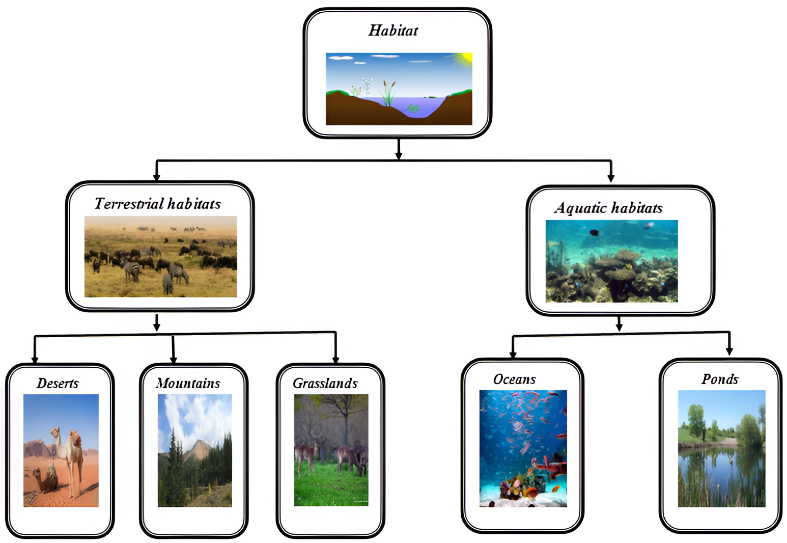
Scales of habitat
Macrohabitat (Large Scale) : Broad geographic regions supporting entire populations (e.g., entire Corbett National Park for tigers).
Medium Scale : Specific zones where individuals survive and reproduce (e.g., territory of a single tiger within Corbett).
Microhabitat (Small Scale) : Specific sites for certain activities like nesting (e.g., tree cavities used by hornbills in Northeast India).
Habitat loss and fragmentation
Habitat loss and fragmentation are severe threats to biodiversity, primarily due to :
Agriculture : Clearing forests in Assam for tea cultivation.
Urbanization : Expansion of cities like Bengaluru, leading to fragmentation of adjoining wildlife corridors.
Deforestation : Timber extraction from dense forests of Western Ghats.
Mining : Coal mining affecting wildlife habitats in Jharkhand and Chhattisgarh.
Pollution : Pollution of Yamuna River affecting aquatic species.
Climate Change : Altered precipitation affecting Himalayan ecosystems, reducing habitat availability for species like the Himalayan musk deer.
Fragmentation isolates wildlife populations, making them vulnerable due to reduced genetic diversity, increased susceptibility to disease, and environmental changes.
Restoration and conservation
Strategies to protect and restore habitats
Protected Areas : Establishing reserves like Kaziranga National Park to safeguard rhinos.
Sustainable Management : Community-based conservation in regions like Nagaland.
Habitat Restoration : Reforestation efforts in degraded areas, such as the restoration of Aravalli forests.
Invasive Species Control : Removal of invasive plants like Lantana camara in tiger reserves across India.
Climate Change Mitigation : Initiatives to lower greenhouse gas emissions and maintain ecosystem resilience.
Education and Awareness : Raising public awareness, exemplified by community programs around Gir Forest to protect Asiatic lions.
Human impacts on habitats
Positive Impacts : Creation of artificial habitats like gardens, urban green spaces, parks, and wildlife corridors which, despite being artificial, support biodiversity.
Negative Impacts : habitat loss, including pollutants like pesticides, heavy metals, plastic waste, and types of development such as roads, dams, and infrastructure projects.
Habitat and climate change
Climate change profoundly influences habitats:
Habitat shifting : Temperature and precipitation shifts lead to changes in the distribution of habitats, forcing species to migrate or adapt.
Range shifts : Species moving to higher latitudes or elevations seeking suitable conditions (e.g., Himalayan species moving upward).
Habitat suitability : Alterations in habitat characteristics due to climate change, affecting species survival and reproduction.
Ocean acidification : Increasing ocean acidity adversely affects coral reefs and marine biodiversity, threatening ecosystems like those in Lakshadweep and Andaman.
Questions from the chapter
Write about Habitat and Niche [UPPSC Forest (Main) 2017, 8 M].
Exam attributions follow the supplied notes.
Related background
Components of Environment: Biotic & Abiotic
Chapter 5 reading order
- Population Ecology: Density, Dispersion and Age Structure
- Natality, Mortality, Life Tables and Survivorship Curves
- Population Growth: Biotic Potential and Environmental Resistance
- Population Regulation: Density Dependent and Independent Factors
- r and K Selected Species: Traits and Human Impacts
- Carrying Capacity: Types and Forest Management Applications
- Population Dispersal and Fluctuation: Causes and Consequences
- Habitat: Components, Types, Fragmentation and Conservation
- Ecological Niche: Types, Roles and Habitat Forming Species
- Ecophene, Ecotype and Ecospecies: Adaptive Responses