
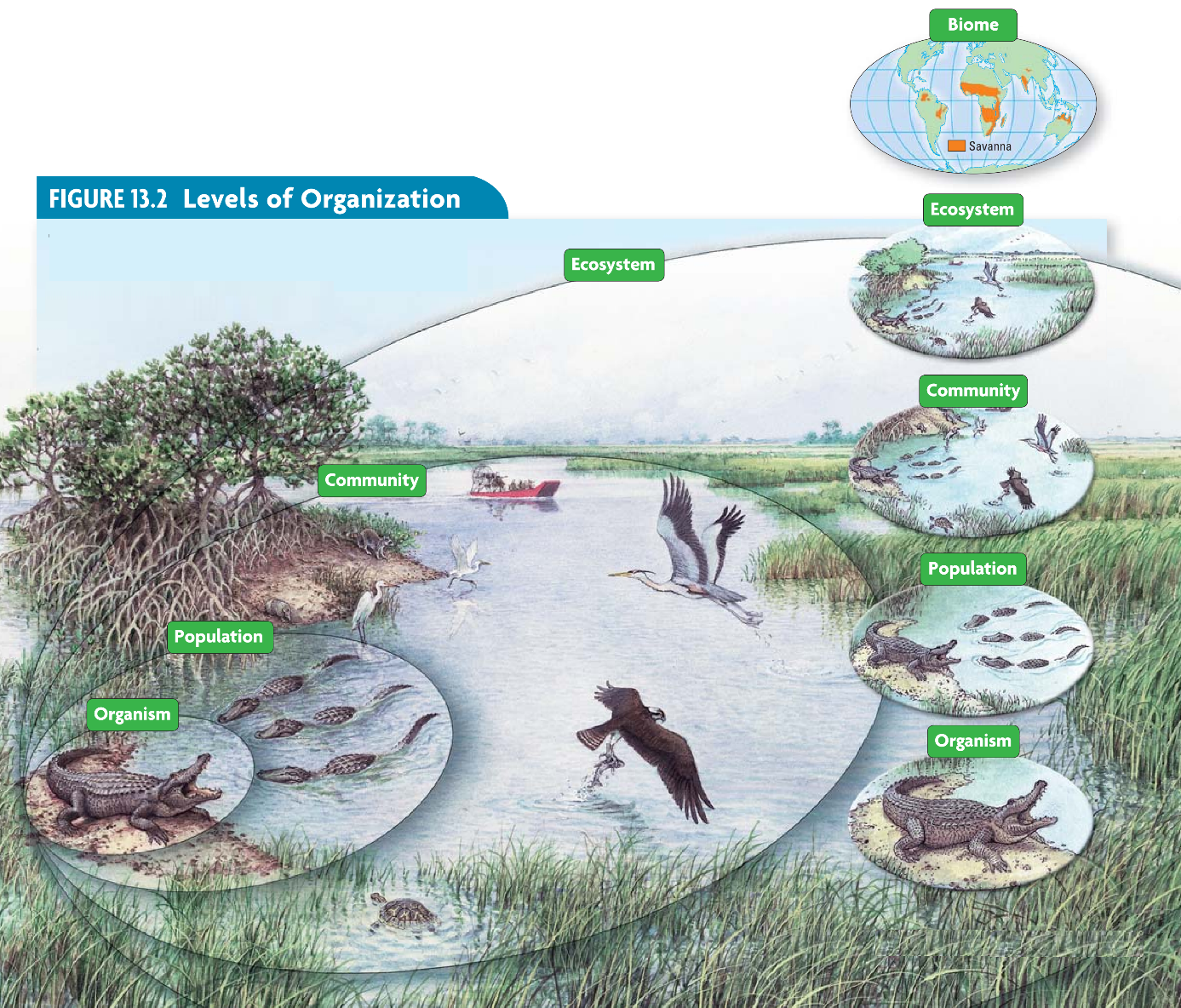
Organization refers to the systematic arrangement and coordination of smaller components into larger, more complex structures in a hierarchical manner. Each level is formed from components of the preceding, lower level, and itself becomes part of the next, higher level.
Organism population and species
Contents / Index
Organism : An individual plant, animal, or microorganism—a distinct living entity composed of one or more cells. It carries out all life processes independently but does not live in isolation. Organisms interact with other organisms, highlighting interdependence. The organism is considered the basic unit of ecological hierarchy.
Population : A population is a group of similar organisms (individuals) inhabiting a specific geographical area.
Populations of the same organism within a specific region are referred to as Local Populations or Demes
A local population genetically adapted to its specific local environment is called an Ecotype
Species : A species is a group of individuals from one or more populations that closely resemble one another in their morphological, physiological, anatomical, biochemical, and genetic traits. Members of a species can interbreed freely and produce viable offspring. The species is regarded as the basic unit of classification.
The level of complexity increases with increasing hierarchy
Community and its characteristics
Community : A community is a group of different species that live together in one area, such as groups of alligators, turtles, birds, fish, and plants that live together in the Satpuda hills.
Terms Biocoenosis is also used for community, which was coined by Carl Mobius. e.g., Forest community, Coral reef community, Microbial community.
Diversity : a variety of species, which contributes to their overall biodiversity.
Abundance : Number of individuals within each species in a community
Interaction : among species can significantly influence community dynamics, e.g., Predation, Mutualism, Parasitism, Competition, Commensalism, etc.
Interactions within a community
Predation : Animals eats plants, and animals eats other animals.
Mutualism : Both species benefit, and they thus rely on each other for survival, e.g., Nitrogen fixing bacteria living in the roots of legumes provide Nitrogen to the plants, while the plants supply food to the bacteria.
Parasitism : One species (Parasite) benefits at the expense of another species (host). The parasite gets its food from the host, hence weakening it.
Commensalism : One species benefits from the relationship, and the other is neither helped nor harmed.
Competition : Human beings compete with many other species for food, space, and other resources.
Population versus community
Both concepts are fundamental in ecology, representing different levels of biological organization. A population consists of individuals of the same species living in a specific area at a given time. These individuals interact with each other and have the ability to reproduce. In contrast, a community includes all the different populations that coexist and interact within a particular area.
On smaller screens, scroll the table sideways to read every column.
| Feature | Population | Community |
|---|---|---|
| Composition | Comprised of individuals of a Single Species | Comprised of Multiple Species |
| Interactions | primarily within the same species (intraspecific) | Interactions include both intraspecific and interspecific relationships (between different species) |
| Size | Generally Smaller and more localized | Larger, encompassing various populations |
| Dynamics | Dynamics are influenced by factors like birth, death, immigration, and emigration within the same species | Dynamics are influenced by interspecies interactions and ecological relationships |
Ecosystem biome and biosphere in the hierarchy
Ecosystem : An ecosystem includes all of the organisms as well as the climate, soil, water, rocks, and other non-living things in a given area. Ecosystems can vary in size. An entire ecosystem may live within a decaying log, which in turn may be part of a larger wetland ecosystem.
Biome : A biome is a large ecosystem or a collection of smaller ecosystems, characterized by a specific climate and geography. Examples include forests, deserts, grasslands, and Tundras.
Biosphere : The biosphere, also called the ecosphere or giant ecosystem, is the largest and nearly self-sufficient biological system. It encompasses all ecosystems on Earth and is referred to as the "life-supporting zone" of the planet.
Questions from the chapter
Different levels of ecological organisation [UPPSC ACF (Main) 2017, Environmental Science Optional | 20 M].
Write a note on – community [UPPSC ACF (Main) 2019, Environmental Science Optional | 8 M].
Differentiate between Community and Population [UPPSC ACF (Main) 2021, Environmental Science Optional | 8 M].
Quick revision
- An organism is the basic unit of ecological hierarchy; species is the basic unit of classification.
- A population contains one species; a community contains different interacting populations.
- Community characteristics include diversity, abundance and interactions.
Related concepts
- Biosphere components — Chapter 3 draft
- Biotic and abiotic components
Chapter 4 reading order
- Ecology: Meaning, History and Branches
- Ecological Organization: Population and Community
- Ecosystems: Meaning, Types and Structure
- Food Chains and Food Webs: Types and Examples
- Biomes: Types and Differences from Ecosystems
- Scope of Ecology: Scales, Data and Applications