
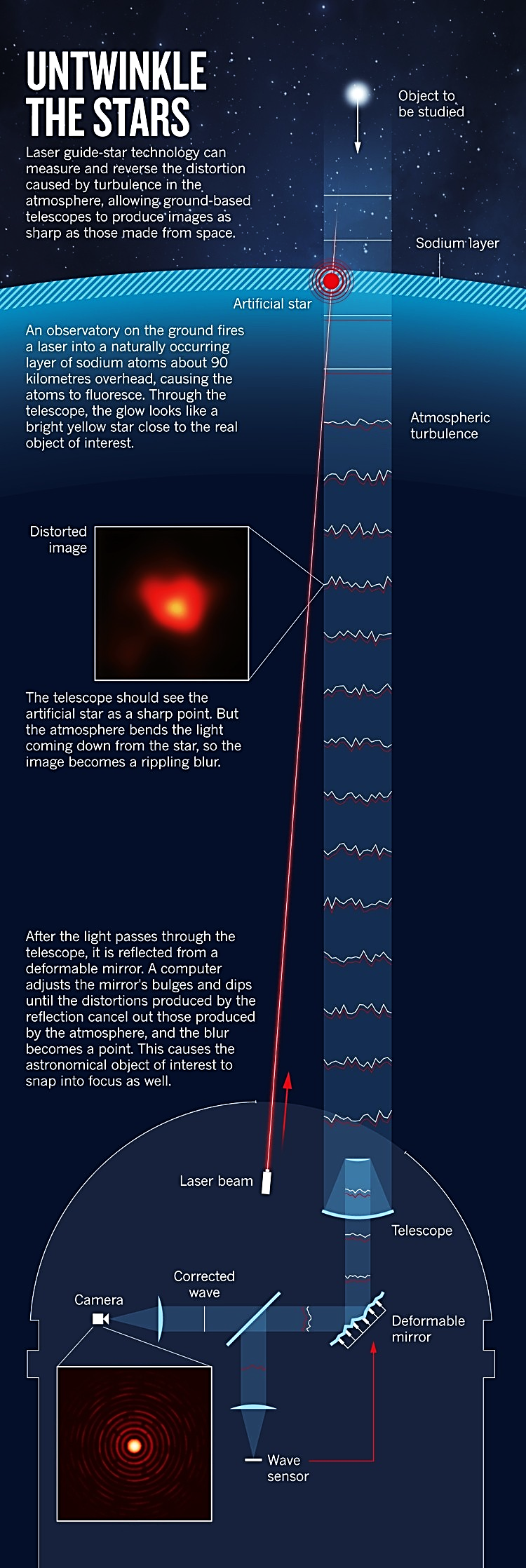
Sodium layer : The presence of sodium in this layer of the atmosphere allows scientists to create "guide stars." These artificial stars help improve the quality of images taken by ground-based telescopes, making astronomical observations more precise and clearer.
Scientists use lasers to illuminate this sodium layer, creating what are called "artificial guide stars" When the laser hits the sodium atoms, it excites them, causing them to glow. This glow simulates a star in the sky.
Ground-based telescopes suffer from atmospheric distortions (e.g., turbulence caused by wind), which can blur images. By using these artificial stars alongside advanced adaptive optics technology, astronomers can measure atmospheric distortions in real time. With the data from the guide stars, telescopes can adjust their optics to compensate for distortions, resulting in clearer and more precise astronomical images.
Contents / Index
How the sodium layer forms
The formation of sodium layers in the atmosphere is primarily influenced by the –
Meteoric ablation, where meteors entering Earth's atmosphere burn up and release sodium and other metal atoms. This process occurs predominantly in the upper mesosphere to lower thermosphere region, contributing to the presence of sodium at altitudes between 75 – 110 km.
Atmospheric Dynamics : The presence of mesospheric frontal systems, play a crucial role in sodium layer formation. These systems create stable temperature profiles and atmospheric stability, which facilitate sodium atoms to be accumulated.
Guide-star diagram: optical pathway
The source diagram shows a ground-based laser illuminating sodium atoms about 90 km overhead. It labels the artificial star, atmospheric turbulence, telescope, wave sensor, deformable mirror, camera and corrected wave. A computer adjusts the mirror to compensate for distortions measured through the guide star.
Quick revision
- Lasers excite sodium atoms to create an artificial guide star.
- Adaptive optics uses guide-star information to compensate for atmospheric distortion.
- The chapter links sodium-layer formation with meteoric ablation and atmospheric dynamics.
Related concepts from Chapter 1
- Abiotic components of environment
- Photosynthesis and biotic–abiotic interactions
- The interdisciplinary nature of environmental science
Related topics
- Mesosphere: Noctilucent Clouds, Meteors and Gravity Waves
- Thermosphere and Ionosphere: Temperature and Radio Communication
Chapter 2 index
- Composition of Atmosphere: Gases, Water Vapour and Dust
- Structure of Atmosphere: Layers, Exosphere, Homosphere and Heterosphere
- Troposphere, Stratosphere and Polar Vortex
- Ozone: Formation, Depletion and Effects on Plants
- Mesosphere: Noctilucent Clouds, Meteors and Gravity Waves
- Thermosphere and Ionosphere: Temperature and Radio Communication
- Aurora and Magnetosphere: Solar Wind and Earth’s Magnetic Field
- Sodium Layer: Artificial Guide Stars and Adaptive Optics