
Aurora Borealis (Northern Lights) : The interaction between charged particles from the sun and the Earth's magnetic field in the thermosphere creates the stunning natural light displays known as the aurora borealis (northern lights) and aurora australis (southern lights).
Contents / Index
How auroras form
Solar Wind : The Sun emits a continuous stream of charged particles, primarily ionized hydrogen (protons) and electrons, known as solar wind. During solar storms, events like solar flares and coronal mass ejections (CMEs) can significantly enhance this wind, sending more energetic particles toward Earth.
Earth's Magnetic Field : As solar wind approaches Earth, it interacts with the planet's magnetic field, which captures some of these particles and directs them toward the polar regions. This magnetic interaction is crucial for the formation of auroras.
Atmospheric Interaction : When the captured solar particles collide with atoms and molecules in Earth's upper atmosphere (particularly in the ionosphere), they transfer energy, causing these atoms to emit light. The specific colors produced depend on the type of gas involved and the altitude of the collisions
Importance of auroras
Scientific Insight : Studying auroras provides valuable information about solar activity and its effects on Earth's magnetosphere, which is essential for predicting space weather events that can impact satellite operations and communication systems.
Tourism : The aurora borealis attracts visitors from around the world. It is most commonly observed during winter months when nights are longer and skies are clearer, particularly near the magnetic poles.
Factors affecting aurora formation
Altitude of Collisions : The height at which solar particles collide with atmospheric gases
Gas Composition : Different gases present in varying concentrations at different altitudes
Energy levels of incoming solar particles
Magnetosphere
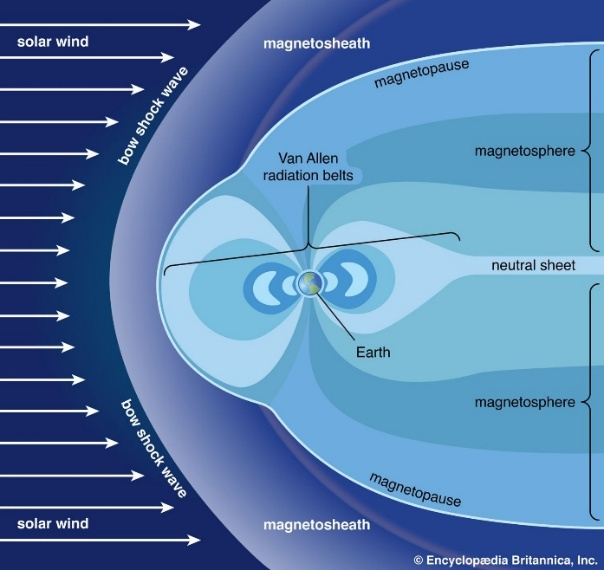
Magnetosphere : The magnetosphere is the region of space around Earth dominated by the planet's magnetic field. It acts as a protective shield, deflecting solar wind and cosmic radiation.
Structure of the magnetosphere
Bow Shock : The outermost boundary where solar wind slows abruptly due to the Earth's magnetic field.
Magnetopause : The boundary separating the magnetosphere from the surrounding solar wind.
Magnetotail : The elongated part of the magnetosphere extending away from the Sun.
Radiation Belts (Van Allen Belts) : Zones within the magnetosphere where charged particles are trapped.
Quick revision
- Auroras result from interactions involving solar charged particles, Earth’s magnetic field and atmospheric gases.
- Aurora appearance depends on collision altitude, gas composition and incoming particle energy.
- The magnetosphere is dominated by Earth’s magnetic field.
- Its named structures include bow shock, magnetopause, magnetotail and Van Allen belts.
Related concepts from Chapter 1
- Abiotic components of environment
- Photosynthesis and biotic–abiotic interactions
- The interdisciplinary nature of environmental science
Related topics
Chapter 2 index
- Composition of Atmosphere: Gases, Water Vapour and Dust
- Structure of Atmosphere: Layers, Exosphere, Homosphere and Heterosphere
- Troposphere, Stratosphere and Polar Vortex
- Ozone: Formation, Depletion and Effects on Plants
- Mesosphere: Noctilucent Clouds, Meteors and Gravity Waves
- Thermosphere and Ionosphere: Temperature and Radio Communication
- Aurora and Magnetosphere: Solar Wind and Earth’s Magnetic Field
- Sodium Layer: Artificial Guide Stars and Adaptive Optics