
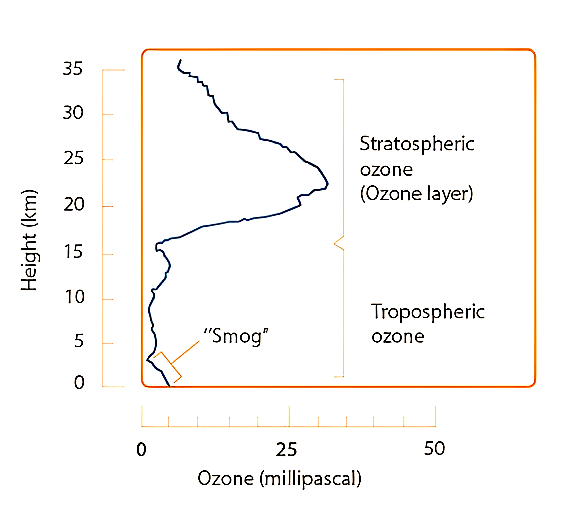
Ozone is a Triatomic Allotrope of Oxygen, consisting of three oxygen atoms (O₃), unlike the more common diatomic oxygen (O₂). This unique structure gives ozone distinct chemical properties. It is primarily found in two layers of Earth's atmosphere.
Stratosphere : Contains about 90% of the total atmospheric ozone.
Troposphere : Contains the remaining 10% of ozone.
Ozone molecules are chemically the same in both layers, consisting of three oxygen atoms. However, they influence humans and other organisms in a totally different way.
Contents / Index
Stratospheric ozone: a protective shield
As it plays a vital role in protecting life on Earth by absorbing harmful ultraviolet (UV) radiation. In particular, effectively filters out most of UV-B radiation, which is known to cause biological damage.
Tropospheric ozone: a harmful secondary pollutant
Tropospheric ozone is a toxic photochemical oxidant formed through the interaction of solar radiation with primary pollutants, such as nitrogen oxides (NOₓ) and volatile organic compounds (VOCs). It poses significant risks to human health, animals, and plants, making it a major environmental concern.
Stratospheric ozone formation
Stratospheric ozone forms naturally through chemical reactions driven by solar ultraviolet (UV) radiation and oxygen molecules.
First, UV radiation strikes an oxygen molecule (O₂), splitting it into two highly reactive oxygen atoms (O•). Each of these atoms then reacts with another oxygen molecule to form an Ozone molecule (O₃). These reactions occur continuously in the presence of UV radiation.
O2 → 2 O• (UV radiation)
O• + O2 + m → O3 + m
Here, “m” represents a third-body molecule that absorbs excess energy.
Tropospheric ozone formation
Tropospheric Ozone : Forms near the Earth's surface through chemical reactions primarily involving hydrocarbons, nitrogen oxides (NOₓ), and ozone itself, all of which require sunlight to proceed. The combustion of fossil fuels serves as a major source of the pollutant gases that drive the production of tropospheric ozone.
NOx + VOC → O3 (sunlight)
Ozone depletion
Photodissociation
Photodissociation of Ozone : Ozone absorbs UV radiation and is broken down into diatomic oxygen (O₂) and a free oxygen atom.
O3 → O2 + O• (UV radiation, 200–300 nm)
O• + O3 → 2O2
Catalytic destruction
Catalytic Destruction : Certain chemicals, particularly those containing chlorine (Cl) and bromine (Br), act as catalysts in ozone depletion. For example, chlorofluorocarbons (CFCs), once widely used in refrigeration and aerosol sprays, release chlorine atoms upon exposure to UV light in the stratosphere. These chlorine atoms can destroy thousands of ozone molecules.
Cl + O3 → ClO + O2
ClO + O• → Cl + O2
This cycle allows a single chlorine atom to destroy thousands of ozone molecules before it is eventually removed from the stratosphere
Volcanic Eruptions, Unregulated Rocket Launches : such types of events can inject sulphur dioxide and other gases into the stratosphere, which can lead to temporary ozone depletion.
Dry deposition and surface reactions
Tropospheric ozone can also be destroyed when it reacts with surfaces such as soils and plants through processes known as Dry Deposition and Surface Reactions.
Dry Deposition : Ozone molecules directly interact with the surface of soils, plant leaves, and other surfaces. Example – when Ozone enters through the stomata (tiny pores) in leaves and reacts with water, lipids, and other organic compounds, often damaging the plant tissue in the process.
Surface Reactions : When ozone contacts surfaces, its highly reactive nature causes it to oxidize molecules present on the surface, such as waxes on plant cuticles or minerals in the soil. These reactions neutralize the ozone, turning it into less reactive compounds, such as oxygen (O₂) or water-soluble products.
Effects of tropospheric ozone on plants
Reduction in Photosynthesis : When ozone molecules enter plant leaves through stomata, they generate reactive oxygen species (ROS) such as superoxide radicals (O₂⁻), hydrogen peroxide (H₂O₂), and hydroxyl radicals (OH). These ROS damage chloroplasts and degrade photosynthetic enzymes (like Rubisco), disrupting photosynthetic processes.
Stomatal Dysfunction : Ozone interferes with the signaling pathways that regulate stomatal opening and closing. This can lead to either excessive stomatal closure, restricting CO₂ uptake, or a failure to close stomata, leading to increased water loss and dehydration.
Chlorosis : The breakdown of chlorophyll due to ozone damage results in chlorosis, the yellowing of leaves. This reduces the plant's ability to absorb light energy for photosynthesis.
Premature Leaf Senescence : Ozone accelerates the aging process of leaves.
The combined effects of reduced photosynthesis, stomatal dysfunction, and leaf damage limit the plant's ability to produce and utilize resources. This leads to stunted growth, reduced flower and fruit production, and ultimately lower crop yields.
Ozone-stressed plants have weakened immune systems, making them more susceptible to diseases and pests.
Altered Gene Expression : Ozone exposure triggers changes in gene expression, affecting various metabolic pathways and enzyme activities. It also alters antioxidant defence mechanisms that can mitigate oxidative damage caused by ozone.
Chemistry of the ozonosphere
The chemistry of the Ozone dynamics (Its formation and destruction) governed by a series of photochemical reactions driven by solar UV radiation. This cycle is known as the Chapman Cycle.
Adverse effects of ozone-layer depletion
Impact on Human Health : Increased exposure to UV-B radiation leads to higher incidences of Skin Cancer (melanoma and non-melanoma) and Cataracts.
It weakens the Human Immune System, increasing susceptibility to infections.
Effects on Terrestrial Ecosystems : UV-B radiation adversely affects plant growth by reducing photosynthesis and damaging DNA.
Effect on Marine Ecosystems : Phytoplankton, the base of aquatic food webs, suffer reduced photosynthesis, destabilizing fisheries. Coral bleaching and larval fish mortality rise.
Material Degradation : UV radiation accelerates the breakdown of polymers, paints, and rubber, escalating maintenance costs for infrastructure and cultural heritage.
For plant effects, see the section “Effects of tropospheric ozone on plants” above.
Questions from the chapter
Write on the – Write about the Formation and Depletion of Stratosphere and Troposphere Ozone and list major effects of tropospheric ozone on plants [Himachal RFO (Main) 2017 Environmental Science Optional | 15 M].
IFoS 2015 : Write the chemistry of ozonosphere and list the adverse effects of ozone layer depletion [10 M].
Write about the causes and effects of ozone depletion
ओजोन की कमी के कारण एवं ओजोन का क्रमिक ह्रास के विषय में लिखिये । [UPPSC ACF (Main) 2017, Environmental Science Optional | P2/3(b) | 20 M].
Exam attributions follow the supplied chapter.
Quick revision
- The chapter allocates about 90% of atmospheric ozone to the stratosphere and 10% to the troposphere.
- UV-driven reactions form and break down ozone.
- The chlorine reaction cycle regenerates chlorine while destroying ozone.
- Tropospheric ozone affects photosynthesis, stomata, leaf condition and plant growth.
- Ozone-layer depletion affects human health, ecosystems and materials.
Related concepts from Chapter 1
- Abiotic components of environment
- Photosynthesis and biotic–abiotic interactions
- The interdisciplinary nature of environmental science
Related topics
Chapter 2 index
- Composition of Atmosphere: Gases, Water Vapour and Dust
- Structure of Atmosphere: Layers, Exosphere, Homosphere and Heterosphere
- Troposphere, Stratosphere and Polar Vortex
- Ozone: Formation, Depletion and Effects on Plants
- Mesosphere: Noctilucent Clouds, Meteors and Gravity Waves
- Thermosphere and Ionosphere: Temperature and Radio Communication
- Aurora and Magnetosphere: Solar Wind and Earth’s Magnetic Field
- Sodium Layer: Artificial Guide Stars and Adaptive Optics