
Population dynamics is the study of how populations change in size, composition, and distribution over time. It examines factors that influence population growth, stability, and decline, helping ecologists, demographers, and policymakers understand species survival, ecosystem balance, and resource management.
Factors influencing population change
Contents / Index
The size of a population is influenced by various processes that either increase or decrease the number of individuals. These factors include :
Births (B) : The number of individuals born into a population over a specific period.
Immigration (I) : The movement of individuals into a population from other areas.
Deaths (D) : The number of individuals that die due to natural causes, predation, disease, or other factors.
Emigration (E) : The movement of individuals out of a population to other regions.
These processes are summarized by the fundamental population change equation :
Nt = Nt−1 + B + I – D – E
Where :
Nt = Population size at time t
Nt−1 = Population size at the previous time t−1
B = Number of births during the interval t−1 to t
I = Number of immigrants into the population
D = Number of deaths
E = Number of emigrants leaving the population
Biotic potential
Biotic potential, represents the Theoretical Maximum number of offspring an organism population could produce if everything was absolutely perfect. Think of it as the elephant's "reproductive dream." This means abundant food (grasses, bamboo, fruits), ample water sources, no poaching or habitat loss, no diseases, plenty of mating opportunities, and ideal climate conditions year-round. Under such utopian circumstances, female elephants would calve at the earliest possible age, have short inter-birth intervals, and all calves would survive to adulthood and reproduce successfully. This is, of course, highly unrealistic.
Intrinsic rate of natural increase
The intrinsic rate of natural increase (r) is a way to Measure this biotic potential. It's the per capita rate of population growth – essentially, the birth rate minus the death rate – under those same perfect conditions. For our elephants, a positive 'r' would indicate population growth, with a higher 'r' signifying faster growth.
Environmental resistance
But the Western Ghats, while rich, are not a limitless paradise. This is where environmental resistance comes into play. It's the sum total of all the factors that Prevent the elephant (or tiger) population from reaching its biotic potential. These factors are numerous and interconnected
Limited Food Resources : While the forest provides food, it's not infinite. During dry seasons, food scarcity can become a major constraint. Competition with other herbivores, like gaur or sambar deer, further limits resources.
Habitat Loss and Fragmentation : Human activities, such as agriculture, infrastructure development, and logging, shrink and fragment elephant habitat, reducing the available resources and increasing human-elephant conflict.
Poaching : Sadly, the illegal hunting of elephants for ivory remains a significant threat, directly reducing the population size.
Disease : Lion, like any other species, are susceptible to diseases, which can impact survival and reproductive rates, e.g., Canine distemper virus.
Original-source note: The source switches from the elephant example to lions and canine distemper in this point. The original example is retained.
Predation (for calves) : While adult elephants have few natural predators, young calves can be vulnerable to tigers or other predators.
Competition : Competition can occur between different elephant family, competing for the same resources, and this can limit growth.
Natural Disasters : Events like wildfires, Wayanad landslide, etc. can affect population growth.
The combined effect of all these environmental resistance factors leads to a Carrying Capacity (K). This is the maximum number of elephants that the Western Ghats ecosystem can sustainably support over the long term. It's the point where the elephant population size stabilizes because the birth rate and death rate become roughly equal due to the limitations imposed by the environment. The carrying capacity might be, say, 500 elephants in a particular area. If the population temporarily exceeds this number, resources become scarcer, mortality increases, and/or reproduction decreases, bringing the population back down towards K.
Understanding these concepts is critical for effective wildlife conservation and management (e.g., Cheetah project). It helps us determine sustainable population levels, identify key threats, and implement strategies to mitigate those threats and maintain healthy ecosystems.
Types of population growth
Exponential growth
Exponential growth occurs when there are no environmental constraints on population expansion. In this type of growth, the population increases by a Constant Multiplier. A simple example is binary fission in protozoa, where each individual splits into two during reproduction, leading to a rapid increase in numbers.
Exponential growth is typically observed in controlled laboratory conditions, where excess organisms are removed to prevent overcrowding. In natural ecosystems, such growth is rare and only occurs when resources are exceptionally abundant, leading to a rapid population surge.
If plotted on a graph would provide a J-Shaped Curve.
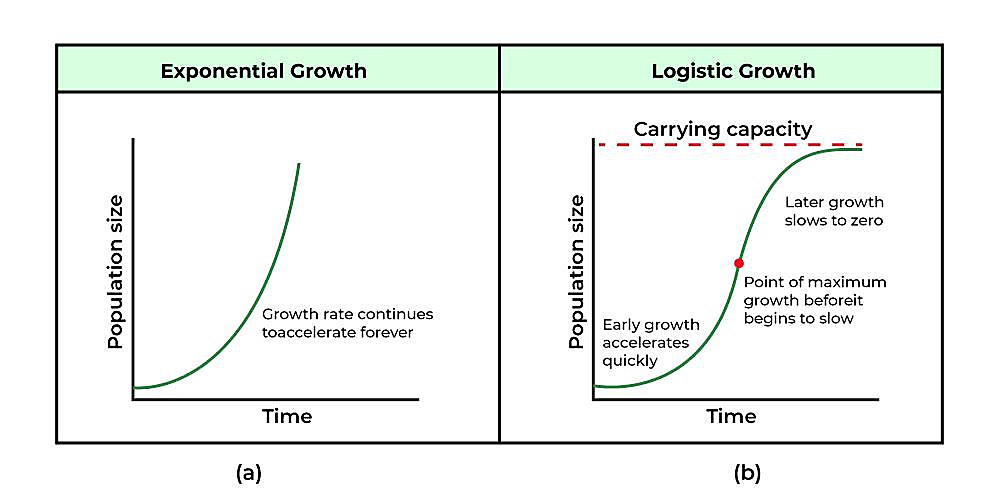
The Intrinsic Rate of Increase (r) can be calculated if natality (birth rate) and mortality (death rate) are known. However, most populations do not exhibit sustained exponential growth because environmental factors impose limits. These limits define the Carrying Capacity (K) — the maximum population size that an environment can support.
The graph reveals a dramatic boom-and-bust cycle in the thrips population inhabiting cassava fields. Between April and May, the number of these tiny insects exploded, closely tracking the predicted exponential growth curve. However, this rapid expansion was short-lived, culminating in a catastrophic decline, possibly triggered by resource depletion.
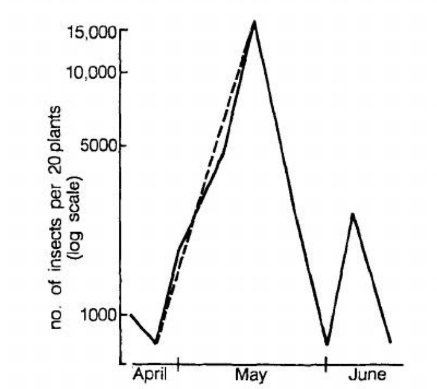
Nature often showcases a "Boom and Bust" cycle. Under ideal conditions, a population might surge exponentially, taking full advantage of ample food and favourable climate. But this rapid expansion inevitably hits a wall. As resources dwindle or conditions shift, the population can experience a catastrophic decline.
Logistic growth
Logistic growth occurs when population expansion is initially rapid but slows as environmental resistance increases. Unlike exponential growth, which continues unchecked, logistic growth is regulated by the Carrying Capacity (K) of the environment—the maximum population size that available resources can support.
At first, the population grows nearly exponentially due to abundant resources. However, as the population size increases, factors such as competition for food, space, and other resources, loss of female fecundity, increasing egg mortality, etc. limit further growth. Eventually, the population stabilizes around the carrying capacity, forming an S-shaped (sigmoidal) growth curve.
Questions from the chapter
What is the future of a growing population in a limited space? Illustrate With an example? [IGNFA (Probation) 2010-12, 10 M].
Exam attributions follow the supplied notes.
Related background
Environment: Meaning, Definitions, Scope and Importance
Chapter 5 reading order
- Population Ecology: Density, Dispersion and Age Structure
- Natality, Mortality, Life Tables and Survivorship Curves
- Population Growth: Biotic Potential and Environmental Resistance
- Population Regulation: Density Dependent and Independent Factors
- r and K Selected Species: Traits and Human Impacts
- Carrying Capacity: Types and Forest Management Applications
- Population Dispersal and Fluctuation: Causes and Consequences
- Habitat: Components, Types, Fragmentation and Conservation
- Ecological Niche: Types, Roles and Habitat Forming Species
- Ecophene, Ecotype and Ecospecies: Adaptive Responses