
Productivity is usually measured as the rate at which energy or biomass is produced per unit area, per unit time. This rate is expressed in terms such as kilocalories per square per year (kcal/m2/yr) for energy, and germs per square meter per year for biomass.
Source-review note: The original wording “germs per square meter” and “kilocalories per square per year” is retained. Earlier units are g/m²/yr and kcal/m²/yr; these inconsistent unit descriptions require source review.
Different methods for measuring productivity are discussed below :–
Harvest method
Contents / Index
Harvest Method : Commonly used to estimate the amount of plant material produced within a specific time frame in terrestrial ecosystems, particularly in cultivated lands and annual plant communities.
∆B = B₂ – B₁
Where, ∆B = Change in biomass in the community between times t₁ and t₂,
B₁ = Biomass at time t₁,
B₂ = Biomass at time t₂.
Two potential losses must be accounted for in this measurement:
L = Biomass lost due to the death of plants or plant parts before the final harvesting,
G = Biomass lost to consumer organisms, such as rodents and pests.
Thus, Net Primary Production (NPP) is calculated as :
NPP = ∆B + L + G
This method is most effective when production begins at zero (seedling or planting) and reaches its peak at harvest time, with minimal losses to consumers during the growth period. It is ideal for assessing the total yield of such ecosystems.
Advantages of harvesting
Accuracy : It provides the most precise estimates of biomass and productivity compared to other methods.
Source-review note: The unqualified claim “most precise” is retained; the source does not state comparison conditions.
It directly measures the actual biomass produced, reducing errors associated with subjective estimations.
This method requires less observer training compared to estimation-based techniques.
Limitations of harvesting
Destructive Nature : The method involves clipping vegetation, which can disturb the ecosystem and make it unsuitable for long-term monitoring.
Time and Labor Intensive.
Seasonal Variability : Results can vary depending on the timing of sampling since plant growth fluctuates throughout the year.
Seasonal and annual climatic fluctuations can affect biomass production, complicating comparisons across years.
Light and dark bottle method
Light and Dark Bottle Method : This method measures primary productivity in aquatic ecosystems, such as ponds, by analysing oxygen production.
Water samples containing plankton communities are placed at different depths in paired bottles, typically 300 ml each. One bottle is made dark by painting it black to block light (for respiration measurement), while the other bottle remains clear to allow light penetration for photosynthesis.
After the incubation period, oxygen levels are measured using Winkler's method. The differences in oxygen levels between the bottles estimate productivity as follows :
Net Photosynthesis = Oxygen in Light bottle – Oxygen in Initial bottle
Respiration = Oxygen in Initial bottle – Oxygen in Dark bottle
Gross Photosynthesis = Oxygen in Light bottle – Oxygen in Dark bottle

| Depth (m) | Light | Dark | Light − Dark |
|---|---|---|---|
| 0 | +4.0 | −2.0 | 6.0 |
| 10 | +2.6 | −1.9 | 4.5 |
| 20 | +1.6 | −1.7 | 3.3 |
| 30 | +0.8 | −1.6 | 2.4 |
| 40 | +0.3 | −1.3 | 1.6 |
| 50 | −0.2 | −1.1 | 0.9 |
| 60 | −0.5 | −0.9 | 0.4 |
| 70 | −0.7 | −0.7 | 0.0 |
Carbon dioxide flux method
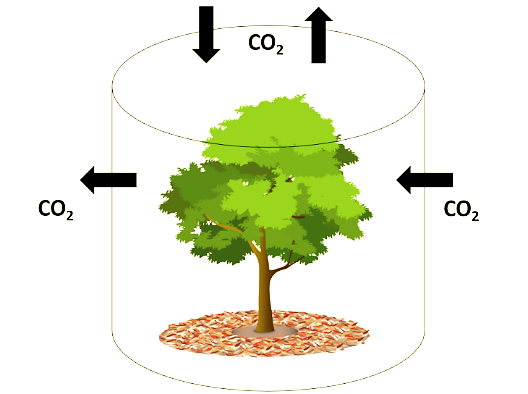
Carbon Dioxide Flux Method : Predominantly used to estimate Primary Productivity in Terrestrial Ecosystems such as forests, grasslands, and agricultural fields.
This method involves measuring the uptake of carbon dioxide (CO₂) during photosynthesis and its release during respiration. Typically, a transparent enclosure, such as a clear plastic tent, is placed around small plants, and the concentration of CO₂ in the incoming and outgoing air is measured using an infrared gas analyser.
By performing this measurement in daylight, the net photosynthetic rate can be obtained. A similar setup with an opaque enclosure provides data on respiration alone. Combining both measurements helps calculate gross primary productivity.
Chlorophyll concentration method
Chlorophyll Concentration Method : This method estimates primary productivity primarily in aquatic ecosystems such as lakes, rivers, and oceans. It measures chlorophyll concentration, as chlorophyll is directly related to photosynthetic activity and biomass. Samples of water are collected, and pigments such as chlorophyll are extracted and measured using a spectrophotometer. Higher chlorophyll concentrations typically indicate higher phytoplankton biomass and potential productivity.
This method was initially developed for aquatic environments, later it expanded to terrestrial ecosystems by assessing chlorophyll in plant leaves. However, accuracy can vary because different species contain varying chlorophyll levels and pigment extraction efficiency.
Radioactive tracer method
Radioactive Tracer Method : A sensitive technique commonly used to measure primary productivity in aquatic ecosystems, especially oceans and lakes. It involves adding radioactive carbon isotope (¹⁴C-labelled CO₂) to water samples. Phytoplankton assimilate this radioactive carbon during photosynthesis. By measuring the radioactivity within phytoplankton cells, researchers calculate the rate of carbon fixation.
Despite its sensitivity, this method has limitations. It cannot differentiate carbon uptake between phytoplankton and bacteria or account for species-specific differences in light utilization. Additionally, a correction factor must be applied to account for potential methodological discrepancies.
Chapter 6 reading order
- Energy Flow in Ecosystems: Processes and Thermodynamic Laws
- Energy Flow Models: Single Channel, Y Shaped and Universal
- Biomass: Types, Accumulation and Energy Uses in India
- Ecosystem Productivity: Primary, Secondary and Influencing Factors
- Methods of Measuring Primary Productivity
- Primary Productivity Patterns in Terrestrial and Aquatic Ecosystems