
An ecological niche refers to the Role or Functional Position a species has within its environment—how it meets its needs for food and shelter, how it survives, and how it reproduces.
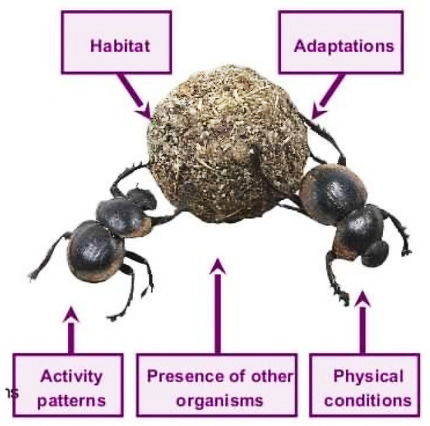
This concept encompasses the ❶ Habitat in which the organism lives, ❷ the organism’s activity pattern (period of time during which it is active), ❸ the resources it obtains from the habitat.
The term "niche" in ecology was first introduced by Joseph Grinnell in 1917. Grinnell defined a niche primarily as the habitat occupied by a species, emphasizing the importance of the species' physical environment.
Types of niches
Contents / Index
There are two main types of ecological niches
Fundamental Niche : This includes all the environmental conditions and resources a species can potentially utilize without the presence of limiting factors like competitors or predators. It represents the full range of conditions under which a species can survive and reproduce.
Example : The Indian banyan tree (Ficus benghalensis) can grow in various soil types and moisture levels, from dry to moist conditions. This wide range of suitable environments constitutes its fundamental niche.
Realized Niche : The actual conditions and resources a species uses in its environment, considering limiting factors such as competition and predation. It's a subset of the fundamental niche where the species is actually found.
Aspects of niche
An ecological niche has two key aspects
Environment's Impact on Species : This aspect examines how environmental factors like temperature, water availability, and food sources affect a species' survival and reproduction.
Example : The snow leopard (Panthera uncia) is adapted to cold mountainous regions with sparse vegetation, relying on specific prey like the Himalayan blue sheep. Changes in temperature or prey availability can significantly impact its survival.
Species' Impact on Environment: This aspect looks at how a species influences its surroundings, including alterations to the habitat and interactions with other species.
Significance of a niche
Resource Recycling : Niches help ensure that materials in the environment are used and reused effectively.
Reduced Competition : By having different roles (niches), different species can live together without constantly fighting over the same resources. This promotes stability in the ecosystem.
Understanding the Ecosystem : Knowing the niche of each organism in a habitat allows us to understand:
How resources are distributed.
Who eats whom (predator-prey relationships).
How species cooperate (symbiosis).
The life cycle and behaviours of each species.
Habitat Destruction : If all species tried to occupy the same niche, competition would become extreme, leading to resource depletion and ultimately, the destruction of the habitat.
Original-source note: The habitat-destruction conclusion is reproduced as stated. Conditions for this general claim are not specified in the supplied notes.
Habitat-forming species
Habitat-Forming Species are defined as organisms capable of physically modifying, creating, or significantly altering environmental conditions, thereby facilitating the establishment and maintenance of suitable habitats for various other taxa. Such species are crucial for ecological engineering, offering microhabitats, resource availability, and protection. A quintessential example is the Mangrove ecosystems, notably in the Sundarbans delta, exemplify habitat-forming species through their complex root structures, which stabilize sediments, regulate hydrological processes, and serve as essential breeding and nursery grounds for diverse fauna, including the critically endangered Royal Bengal tiger (Panthera tigris tigris).
Original-source note: The original combines mangrove nursery-ground wording with the tiger example and the label “critically endangered”. Both wording and attribution require source review; no external correction is inserted.
Foundation species
Foundation Species are organisms that create and shape habitats on a large scale, supporting entire ecosystems. These species provide essential structure and stability, helping many other plants and animals survive. distinguishable from habitat-forming species, encompass taxa that profoundly structure entire ecosystems at a broader ecological scale.
Coral reef systems of the Lakshadweep Islands, whose calcareous skeletons form extensive reef habitats critical to marine biodiversity, trophic stability, and ecosystem functioning.
Questions from the chapter
Write about Habitat and Niche [UPPSC Forest (Main) 2017, 8 M].
Write on the following – Ecological niche [UPPSC ACF 2019, 8 M].
Exam attributions follow the supplied notes.
Related background
Biotic and Abiotic Interactions: Energy Flow and Nutrient Cycling
Chapter 5 reading order
- Population Ecology: Density, Dispersion and Age Structure
- Natality, Mortality, Life Tables and Survivorship Curves
- Population Growth: Biotic Potential and Environmental Resistance
- Population Regulation: Density Dependent and Independent Factors
- r and K Selected Species: Traits and Human Impacts
- Carrying Capacity: Types and Forest Management Applications
- Population Dispersal and Fluctuation: Causes and Consequences
- Habitat: Components, Types, Fragmentation and Conservation
- Ecological Niche: Types, Roles and Habitat Forming Species
- Ecophene, Ecotype and Ecospecies: Adaptive Responses