
Population dispersal—the movement of individuals from their birth site to new habitats—plays a pivotal role in shaping the dynamics of species across ecosystems. While natural dispersal ensures species survival and genetic diversity, human-induced environmental changes have amplified its scale and complexity.
Drivers of dispersal
Contents / Index
Resource Scarcity : When food, water, shelter, or suitable mates become scarce in a particular habitat, individuals may be forced to move.
Environmental Shifts : Our planet is in constant flux. Climate change, habitat degradation (due to deforestation, pollution, etc.), and natural disasters (floods, wildfires) can render an area unsuitable, forcing populations to seek greener pastures.
Example : The rising sea levels in the Sundarbans mangrove forest are forcing tigers and other wildlife to move to higher ground, increasing human-wildlife conflict.
Competition : Intra- and interspecific competition for resources, territory, or breeding opportunities can drive individuals to disperse in search of less crowded areas with reduced competition.
Predation Pressure : High predation risk in a particular area may prompt individuals to move to safer locations where they face lower threats.
Mating Opportunities : Dispersal in search of potential mates or to avoid inbreeding promotes gene flow and enhances genetic diversity within populations.
Territorial Behavior : Territorial disputes can lead individuals to relocate to avoid conflicts, thereby influencing their distribution patterns.
Population Density : Elevated population densities can induce dispersal as individuals seek to reduce competition for resources or find more suitable habitats with lower densities.
Anthropogenic Factors : Human activities such as urbanization, habitat fragmentation, deforestation, pollution, and land development can disrupt ecosystems, leading to population dispersal. The introduction of invasive species like Lantana camara has significantly altered forest ecosystems in India, affecting native wildlife habitats.
Consequences of dispersal
Dispersal can have both positive and negative effects on ecosystems and populations, depending on the context and scale of movement.
Positive impacts
Enhanced Genetic Diversity : Dispersal facilitates gene flow between populations, reducing the risk of inbreeding depression and associated genetic issues, thereby strengthening populations.
Range Expansion : By colonizing new habitats, species can expand their range, increasing their chances of survival amid environmental changes.
Reduced Competition : Spreading out can alleviate competition for limited resources in a particular area, leading to more sustainable population densities.
Climate change adaptation : Seed dispersal enables plants to shift their ranges in response to climate change, potentially preventing extinction.
Seed dispersal allows plants to colonize new areas, escape competition with siblings and the parent plant, and avoid pathogens or predators concentrated near the parent. This movement is essential for plant survival and the maintenance of biodiversity, especially in response to environmental change, such as climate change.
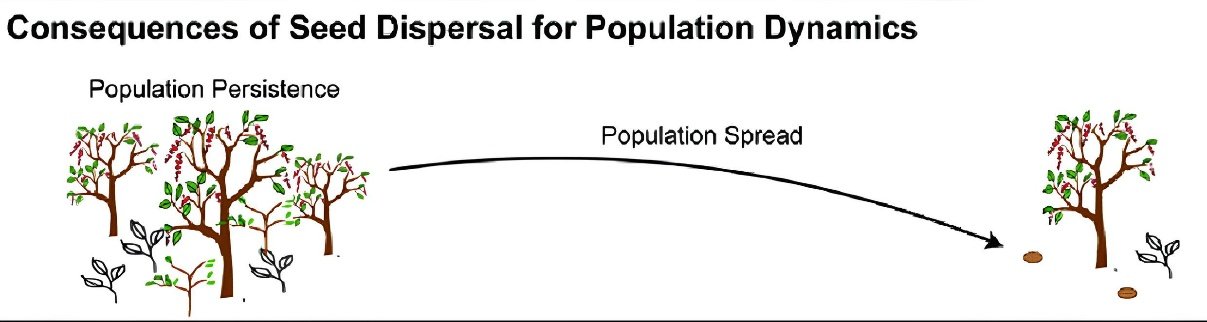
Predator-prey interactions : The dispersal of predators can regulate prey populations, influencing community structure and ecosystem function.
Negative impacts
Invasive Species : Species dispersing to new areas may become invasive, outcompeting local species, disrupting ecosystems, and causing biodiversity loss.
Ecological Imbalance : The departure of keystone species from an ecosystem can lead to imbalances, affecting food chains and overall ecosystem functioning.

Disease transmission : Dispersal can facilitate the spread of diseases among animal populations
Mitigation strategies
To address the negative consequences of dispersal, several strategies can be implemented:
Habitat Protection and Restoration : Safeguarding and restoring natural habitats can prevent species displacement due to habitat loss. Initiatives like reforestation and wetland restoration are crucial.
Wildlife Corridors : Establishing corridors that connect fragmented habitats allows species to migrate without being forced into human-dominated areas. In India, creating such corridors has been vital for species like tigers and elephants to maintain genetic diversity and access essential resources.
Invasive Species Management : Active monitoring and control of invasive species can help prevent the displacement of native species in areas where they disperse.
Climate Change Mitigation : Reducing greenhouse gas emissions can slow down climate change, decreasing the need for species to migrate to more suitable habitats.
Policy Implementation : Enacting policies to protect natural resources and mitigate the environmental impacts of urbanization is essential.
Afforestation & Reforestation : Planting trees in deforested areas can mitigate adverse effects by providing new habitats and resources for wildlife.
Population fluctuation
Population fluctuation refers to the variation in the size of a population over time, influenced by environmental factors, resource availability, predation, disease, and other ecological processes. Understanding population fluctuation helps ecologists predict species survival and manage ecosystems effectively.
Types of fluctuation
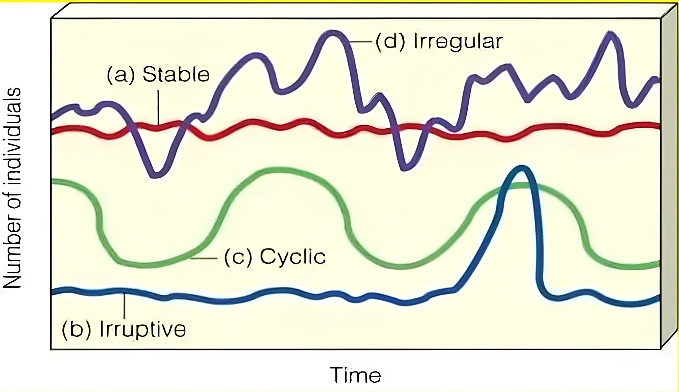
Stable Fluctuation : under this, the population size remains relatively constant, oscillating slightly above or below the environment's carrying capacity. This stability typically occurs in habitats with consistent environmental conditions, such as tropical rainforests, where resources and climate remain largely unchanged throughout the year.
For example, the population of Indian elephants (Elephas maximus indicus) in the stable habitats of the Western Ghats and Northeast India generally exhibits stable fluctuations.
Irruptive Fluctuation : Characterized by periods of relative stability interrupted by sudden population explosions (irruptions), followed by drastic declines (crashes). Such irruptions usually result from temporary surges in resource availability or favorable environmental conditions that temporarily raise the carrying capacity. This pattern is common in short-lived, rapidly reproducing organisms like insects, rodents, and some bird species.
Example : Periodic explosion in populations of rodents in bamboo flowering years in Northeast India, which drastically decline afterward due to the depletion of food resources.
Irregular Fluctuation : A lack clear, predictable pattern, displaying seemingly chaotic variations in population size. The reasons behind irregular fluctuations are complex and often poorly understood.
Example : Populations of flamingos visiting Rann of Kutch, show irregular fluctuations due to inconsistent rainfall and changing water levels.
Cyclic Fluctuation : occur in regular intervals, typically over multi-year cycles. Populations undergoing cyclic fluctuations repeatedly increase and decrease in a predictable manner. This phenomenon can result from predator-prey dynamics, seasonal resource availability, or internal population mechanisms.
Questions from the chapter
Define "Population"? Discuss various factors responsible for dispersal of population and its consequences. What steps would you take to minimize adverse effect of dispersal? [IGNFA, 2011-13, 10 M].
Short notes on – Dispersal movement? [IGNFA, 2013-15, 2M].
Exam attributions follow the supplied notes.
Related background
Flood in Assam and drone for rescuing and monitoring the animal
Chapter 5 reading order
- Population Ecology: Density, Dispersion and Age Structure
- Natality, Mortality, Life Tables and Survivorship Curves
- Population Growth: Biotic Potential and Environmental Resistance
- Population Regulation: Density Dependent and Independent Factors
- r and K Selected Species: Traits and Human Impacts
- Carrying Capacity: Types and Forest Management Applications
- Population Dispersal and Fluctuation: Causes and Consequences
- Habitat: Components, Types, Fragmentation and Conservation
- Ecological Niche: Types, Roles and Habitat Forming Species
- Ecophene, Ecotype and Ecospecies: Adaptive Responses