
Carrying capacity (denoted as K) is the maximum population size of a species that an ecosystem can sustainably support indefinitely without causing environmental degradation. This concept reflects the balance between available resources (e.g., food, water, shelter) and the population’s demand for these resources. Limiting factors—both biotic (e.g., predation, competition) and abiotic (e.g., climate, space)—determine this equilibrium. Exceeding carrying capacity leads to ecosystem damage, population decline, or collapse due to resource depletion.
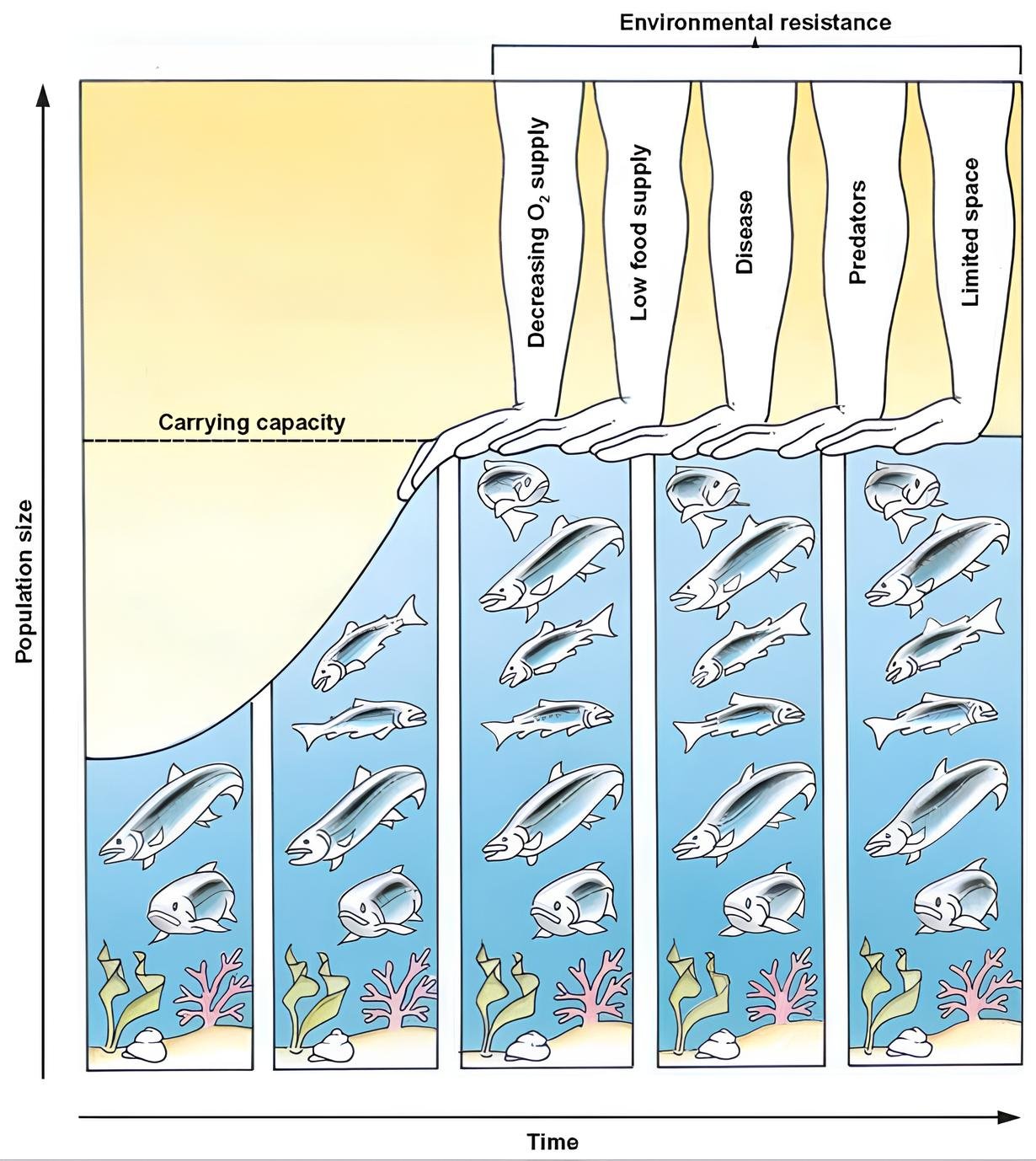
Limiting factors
Contents / Index
The environment's carrying capacity is determined by various Limiting Factors. These are environmental constraints that restrict population growth.
Food & Water Availability : Essential resources for survival and reproduction.
Shelter : Protection from predators.
Competition : Individuals of the same or different species may be rivals for resources. [ + Human impact].
The presence of predator’s controls prey population size.
The spread of disease is more rapid in dense populations, thus acting as a limiting factor.
Space : Sufficient area is needed for foraging, breeding, and establishing territories.
Effects of exceeding carrying capacity
When a population surpasses its environment's carrying capacity, negative consequences arise. These can be
Increased Mortality : Due to resource scarcity and increased competition.
Reduced Reproduction Rates : Limited resources lead to lower birth rates.
Ecosystem Damage : Overuse of resources can degrade the environment, potentially reducing future carrying capacity. Examples include overgrazing leading to soil erosion.
Logistic growth and carrying capacity
Population growth under resource limitations follows an S-shaped logistic growth curve, characterized by three phases
Lag Phase : Slow initial growth due to limited population size.
Exponential Phase : Rapid growth as resources are abundant.
Stationary Phase : Growth rate declines as the population nears “K”, stabilizing at the stable equilibrium ( zero population growth).
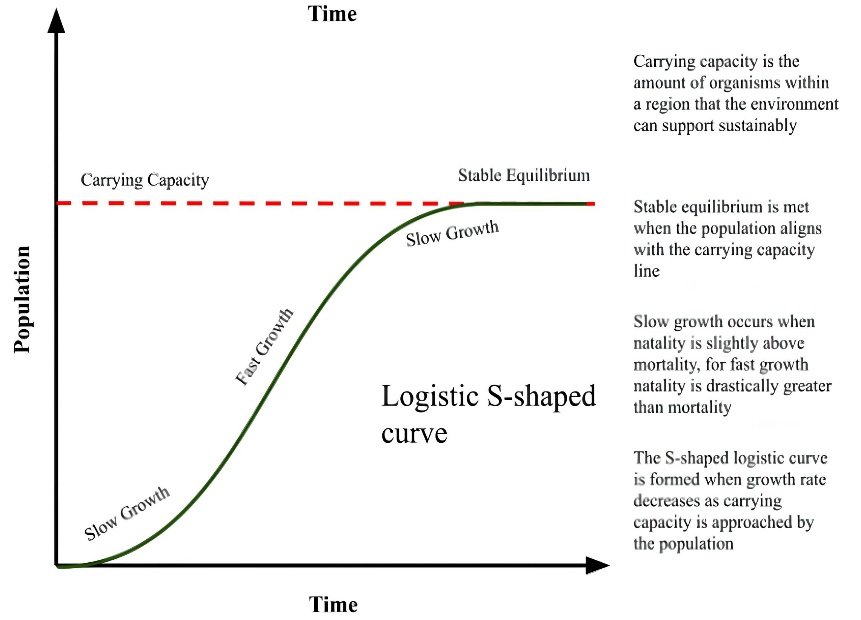
In reality, populations often oscillate around “K” rather than forming a flat line, influenced by dynamic factors like disease, predation, or seasonal resource fluctuations.
Mathematical representation
dN/dt = rN (1 − N/K)
Where :
dN/dt = Rate of population change.
r = Intrinsic rate of increase (maximum reproductive capacity).
N = Current population size
K = Carrying capacity
Types of carrying capacity
On smaller screens, scroll the table sideways to read every column.
| Type | Definition | Key Factors | Example |
|---|---|---|---|
| Physical-Ecological | This refers to the maximum population size that an ecosystem can sustain indefinitely without experiencing long-term damage or degradation. | It focuses on the balance between resource availability, population size, and the overall health of the ecosystem. | A forest's capacity to sustain a deer population without overgrazing. |
| Social Carrying Capacity | This considers the human dimension, referring to the maximum population a community can handle without negative impacts on the quality of life, cultural heritage, or social structures. | Infrastructure, healthcare, cultural values | A small island community may have a limited social carrying capacity due to the strain on infrastructure, services, and community cohesion. |
| Politico-Economic Carrying Capacity | The maximum population a region can support without causing economic or political instability. | It depends on factors like job opportunities, infrastructure, and governance. | Unemployment triggering social unrest. |
Minimum Impact Carrying Capacity : This is crucial in conservation and protected area management. It refers to the maximum number of individuals (often visitors or tourists) that an area can support without causing unacceptable levels of environmental change. This is directly relevant to ecotourism, trail management, and wilderness preservation. It emphasizes minimizing human impact on the ecosystem.
Applications in forest management
The concept of carrying capacity is crucial for sustainable forest management:
Wildlife Conservation : Managing populations of herbivores (e.g., deer) or predators to prevent overpopulation and maintain ecosystem balance.
Habitat Protection : Identifying and protecting critical habitats (e.g., wetlands) to ensure they can support the species that depend on them.
Sustainable Timber Harvesting : Setting limits on timber harvesting to ensure that the forest's natural regeneration rate is not exceeded.
Forest-Based Livelihoods : Supporting local communities that rely on forests for income (e.g., through non-timber forest products) in a way that does not deplete resources.
Forest Tourism : Managing visitor numbers to prevent overuse and damage to sensitive forest ecosystems.
Community Involvement : Including social and cultural factors and engaging local groups in decision-making regarding forest resource management.
Questions from the chapter
Discuss population carrying capacity and population regulating factors? [UPPSC ACF (Main) 2018, 20 M].
Short note on : Carrying capacity? [IGNFA, 2013-15, 2M].
Elaborate on various types of carrying capacity and its applications in forest management? [IGNFA, 2014-16, 10M].
What is carrying capacity and explains its types? [IGNFA, 2015-17, 10M].
Discuss carrying capacity with example? [IGNFA, 2018-20, 5M].
Exam attributions follow the supplied notes.
Related background
Environment: Meaning, Definitions, Scope and Importance
Chapter 5 reading order
- Population Ecology: Density, Dispersion and Age Structure
- Natality, Mortality, Life Tables and Survivorship Curves
- Population Growth: Biotic Potential and Environmental Resistance
- Population Regulation: Density Dependent and Independent Factors
- r and K Selected Species: Traits and Human Impacts
- Carrying Capacity: Types and Forest Management Applications
- Population Dispersal and Fluctuation: Causes and Consequences
- Habitat: Components, Types, Fragmentation and Conservation
- Ecological Niche: Types, Roles and Habitat Forming Species
- Ecophene, Ecotype and Ecospecies: Adaptive Responses