
Reproductive strategies are crucial in shaping how species adapt and survive across different environments. But they're just one piece of the puzzle when it comes to understanding a species' survival and population dynamics. Other factors like interactions with the environment, limited resources, parental care, and competition play significant roles too. These elements influence how populations grow and how unique reproductive strategies develop.
We often categorize these strategies into : ❶ r-selection and ❷ K-selection.
r-Selected species
Contents / Index
These species are adapted to thrive in unpredictable or fluctuating environments. They reproduce quickly, producing a large number of offspring with minimal parental investment. This approach increases the likelihood that some offspring will survive despite high mortality rates.
r-Selected characteristics
High reproductive rates with little to no parental care.
Short lifespan with early maturity.
High fecundity (many offspring per reproductive event) Produce large number of offspring.
High offspring mortality
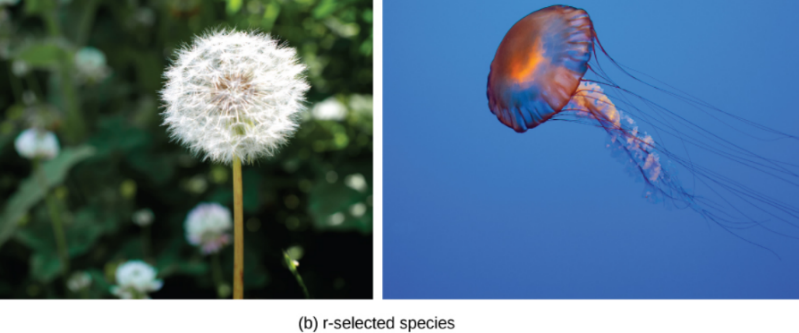
Examples : Organisms such as jellyfish and dandelions exemplify r-selected species. Dandelions produce numerous lightweight seeds dispersed by wind; while only a few seeds may land in suitable locations, the sheer number increases the chances of successful germination.
K-Selected species
on the other hand, these species thrive near the limits of their environment's resources (Carrying Capacity), and focus on raising fewer offspring with higher survival rates. They invest significant resources in nurturing and protecting their young, enhancing their chances of reaching maturity.
K-Selected characteristics
Late maturation and delayed reproduction
Long lifespan
Low fecundity (few offspring per reproductive event)
High parental care
Low offspring mortality
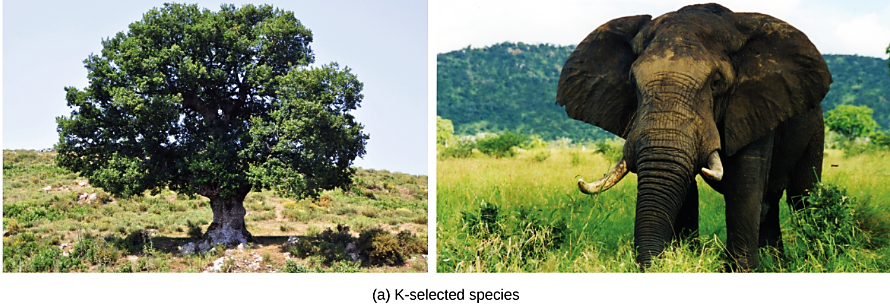
Examples : Species like elephants and humans are typical K-strategists. They have prolonged developmental periods and invest heavily in the upbringing of their offspring, ensuring they acquire the necessary skills and knowledge to survive.
However, the r/K selection model is a simplified view; many species show a mix of both strategies. For example, some plants might produce many seeds during tough times but shift to producing fewer, hardier seeds when conditions are better. This adaptability highlights the complexity of life histories beyond just “ r ” and “ K ” categories.
Original-source note: The general plant example and the mixed-strategy qualification are retained from the notes; no species-specific evidence is supplied for the example.
On smaller screens, scroll the table sideways to read every column.
| r-Selected | K-Selected | |
|---|---|---|
| Environment | Variable and unpredictable | Constant or predictably variable |
| Population characteristics | Survivorship curve concave High fecundity. Density variable usually well below carrying capacity Scramble type intraspecific competition |
Survivorship curve convex. Low fecundity. Density fairly constant at or near carrying capacity Contest-type inter-specific competition |
| Individual characteristics | Small body size Good dispersal powers Low level of social organisation |
Large body size Poor dispersal powers High level of social organisation. |
Original-source note: The original comparison uses “intraspecific” for scramble competition and “inter-specific” for contest competition. This contrast is retained for source review.
Source : Ecology & Environment by P.D. Sharma
Human activities and reproductive strategies
Human activities often create disturbed environments characterized by habitat fragmentation, pollution, resource depletion, and climate change. These disturbances differentially affect r and K-strategists:
r-strategists benefit : Their high reproductive rates and ability to quickly colonize new areas allow them to thrive in disturbed environments. They can rapidly exploit newly available resources and adapt to changing conditions. For example, deforestation can create ideal conditions for weedy r-strategists, while pollution can Favor fast-reproducing microorganisms. The removal of competitors (often K-strategists) further enhances their success.
K-strategists decline : Their low reproductive rates and dependence on stable environments make them vulnerable to human-induced changes. Habitat fragmentation can isolate populations, reducing genetic diversity and making them more susceptible to extinction. Pollution and climate change can alter their preferred habitats, making them unsuitable for survival. The increased competition from thriving r-strategists can also negatively impact K-strategists. For example, elephant populations are declining due to habitat loss and poaching, while oak forests are threatened by deforestation and changing climate patterns.
Questions from the chapter
Short note on : ‘K’ and ‘r’ Selected species? [IGNFA, 2013–15, 5M]
Traits of ‘K’ and ‘r’ selected species? [IGNFA, 2014–16, 2M].
Write about evolutionary strategies adopted by 'k' and 'r' selected species with examples? [IGNFA, 2016-18, 10M].
Explain the difference between the ‘r’ selection and ‘K’ selection reproductive strategies and how these aspects can be used in designing a species recovery program? [IGNFA, 2020-22, 10 M].
Exam attributions follow the supplied notes.
Related background
Environment: Meaning, Definitions, Scope and Importance
Chapter 5 reading order
- Population Ecology: Density, Dispersion and Age Structure
- Natality, Mortality, Life Tables and Survivorship Curves
- Population Growth: Biotic Potential and Environmental Resistance
- Population Regulation: Density Dependent and Independent Factors
- r and K Selected Species: Traits and Human Impacts
- Carrying Capacity: Types and Forest Management Applications
- Population Dispersal and Fluctuation: Causes and Consequences
- Habitat: Components, Types, Fragmentation and Conservation
- Ecological Niche: Types, Roles and Habitat Forming Species
- Ecophene, Ecotype and Ecospecies: Adaptive Responses