
Organisms depend on consuming other organisms for survival. A Food Chain is a linear arrangement of organism in which each one preys on the preceding one, illustrating the predator-prey relationship.
Producers are plants or herbs that are consumed by herbivores, which are themselves eaten by carnivores. Since energy is lost in the form of heat at each trophic level, food chains rarely exceed four to five trophic levels.
Food-chain example
Contents / Index
Grass → Grasshopper → Frog → Snakes → Buzzard (बाज)
It shows how energy, and matter transfer from one trophic level to another.
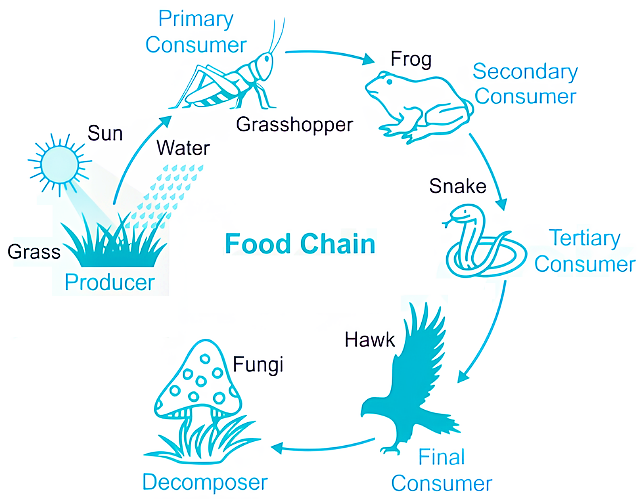
The diagram labels grass as the producer, grasshopper as the primary consumer, frog as the secondary consumer, snake as the tertiary consumer, hawk as the final consumer, and fungi as the decomposer. Sun and water are also shown.
Food chain will always begin with the producer.
Original-source note: The original states that a food chain always begins with the producer, while its detritus-food-chain definition below starts with dead or decaying material. Both original statements are retained; this inconsistency remains for source review.
Types of food chains
Food chain is of two types
Grazing food chain : This type of food chain starts from the living plants.
Detritus food chain : This type of food chain starts from dead or decaying material
Food webs
In nature, the organism of a particular trophic level can be consumed by more than one organism. Moreover, in an ecosystem, more than one food chain runs simultaneously. These chains are interwoven with each other and form a complex web-like as Food web.
A food web shows how plants and animals in a community are connected and depend on each other for food. It helps us understand how matter and energy move through these connections and the relationships between predators and their prey. The complexity of the food web is proportionate to ecosystem stability, which means the more complex the food web is, the more stable the ecosystem.
Original-source note: The complexity–stability relationship is reproduced as stated in the original notes. The supplied text does not state conditions or qualifications for this general claim.
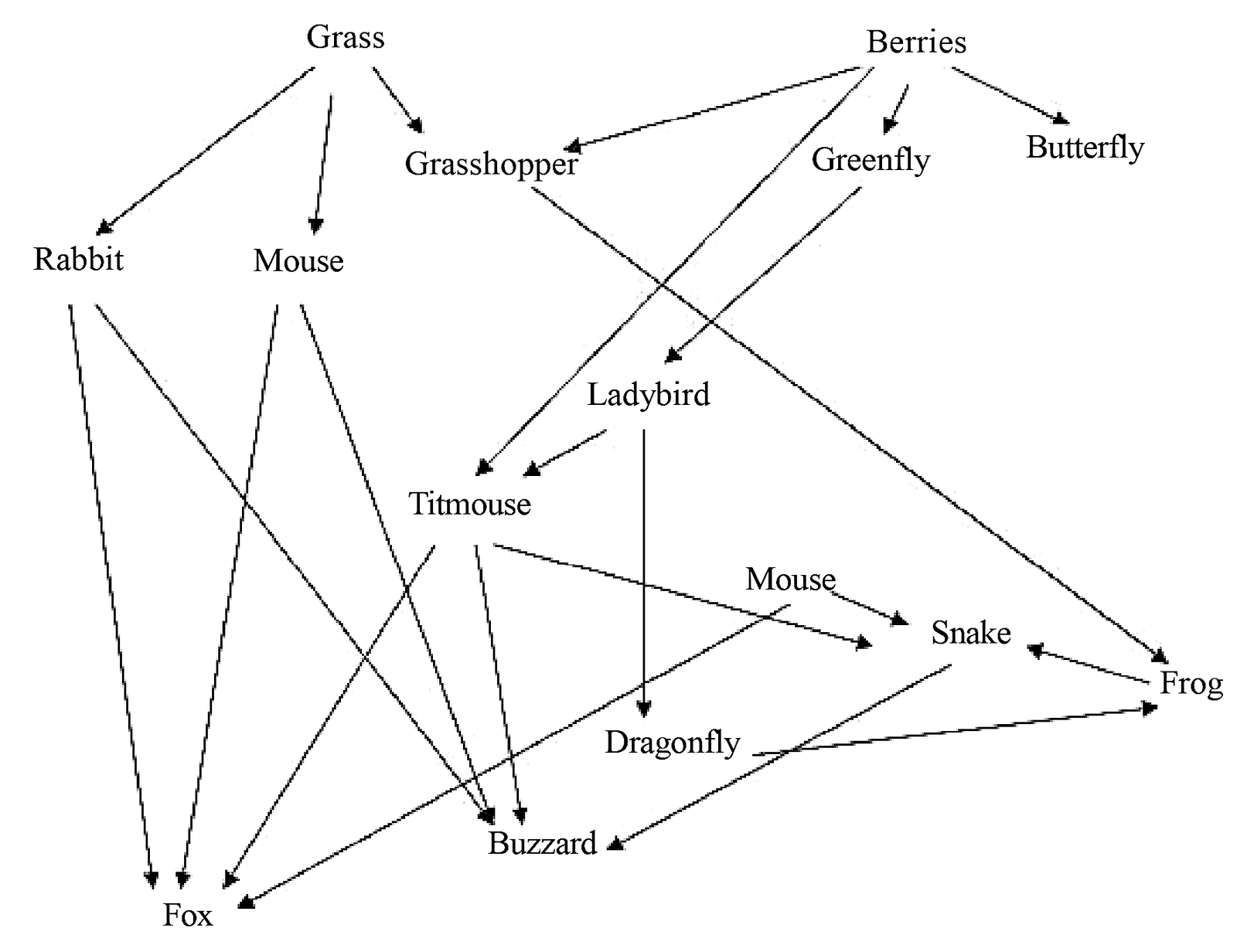
The diagram includes grass, berries, grasshopper, greenfly, butterfly, rabbit, mouse, ladybird, titmouse, dragonfly, snake, frog, fox and buzzard. Its multiple feeding links show the interwoven chains described above.
Quick revision
- A food chain describes a linear feeding sequence and trophic transfers.
- Grazing chains start with living plants; detritus chains start with dead or decaying material.
- Multiple interwoven food chains form a food web.
Related concepts
Chapter 4 reading order
- Ecology: Meaning, History and Branches
- Ecological Organization: Population and Community
- Ecosystems: Meaning, Types and Structure
- Food Chains and Food Webs: Types and Examples
- Biomes: Types and Differences from Ecosystems
- Scope of Ecology: Scales, Data and Applications